
Commissioning of the Final Turbine
A plain-English reconciliation of the planning-permit, endorsed-plan and monitoring obligations that follow from the final-turbine commissioning milestone, together with the presently disclosed date record.
One milestone, several mandatory pathways
The commissioning of the final turbine is not merely a project-history date. The Planning Permit and endorsed management material use that milestone to start, end or measure a number of administrative obligations. Other endorsed material uses closely related wording such as “commencement of operation”. This page preserves the exact source wording while showing how the requirements fit together.
This page does not determine technical compliance. It identifies the trigger, the requirement, the disclosed documentary record and any question that remains open.
How the NCTP obtains authority within the permit framework
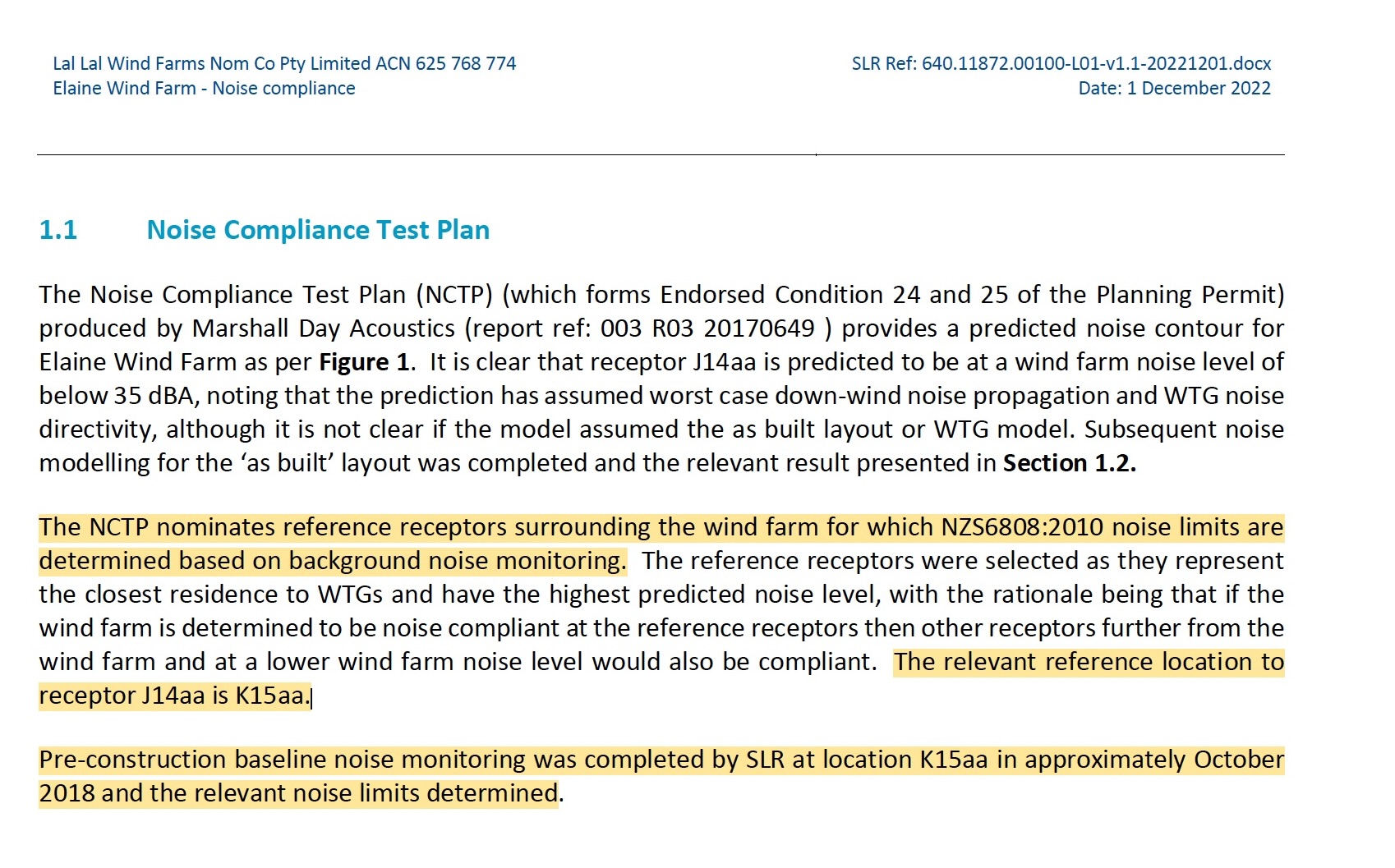
Planning Permit PL-SP/05/0461 is the authorising document for the Lal Lal Wind Farm. Condition 25 requires a Noise Compliance Testing Plan and provides that, once approved and endorsed by the Minister for Planning, the NCTP forms part of the Planning Permit.
Regulation 131B of the Environment Protection Regulations identifies the authorising document as the source that determines the relevant wind farm noise standard, including any conditions that modify or replace requirements of NZS 6808:2010. Within that statutory framework, the endorsed NCTP derives its authority through the Planning Permit and establishes the project-specific noise-testing pathway.
The documents do not use one uniform expression. The Planning Permit refers to commissioning of the facility and full operation of the facility, while the endorsed Noise Compliance Testing Plan (NCTP) establishes the project-specific operational noise pathway using commissioning of the last turbine as the trigger for pre-operation requirements, post-construction noise monitoring, compliance testing and reporting. Once endorsed, the NCTP forms part of the Planning Permit under Condition 25 and therefore sits within the same permit framework as Conditions 12 and 17, which also use, or operate by reference to, commissioning of the last turbine. This page preserves those differences in terminology while demonstrating how the operational noise pathway aligns with the same commissioning milestone reflected elsewhere in the Planning Permit, rather than treating the various expressions as automatically synonymous.
What follows from the trigger?
Read from left to right: the source identifies the trigger, the trigger starts or ends an obligation, and the later record should show what happened next.
Trigger requirements and the disclosed record
This table identifies the controlling trigger, the required administrative step and the presently disclosed documentary position. The detailed source reconciliation follows below.
| Source | Exact trigger or timing concept | What was required | Present documentary position |
|---|---|---|---|
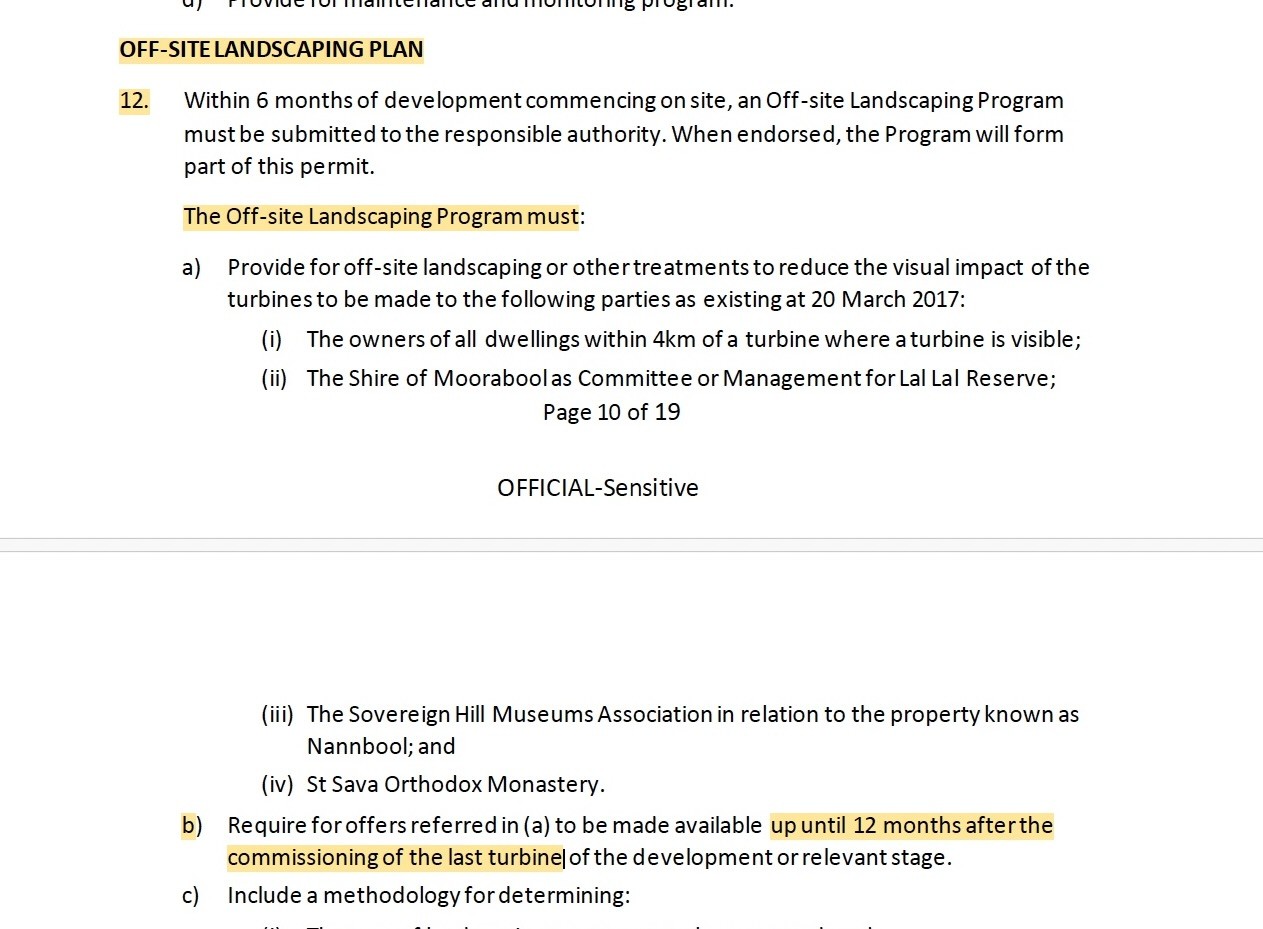
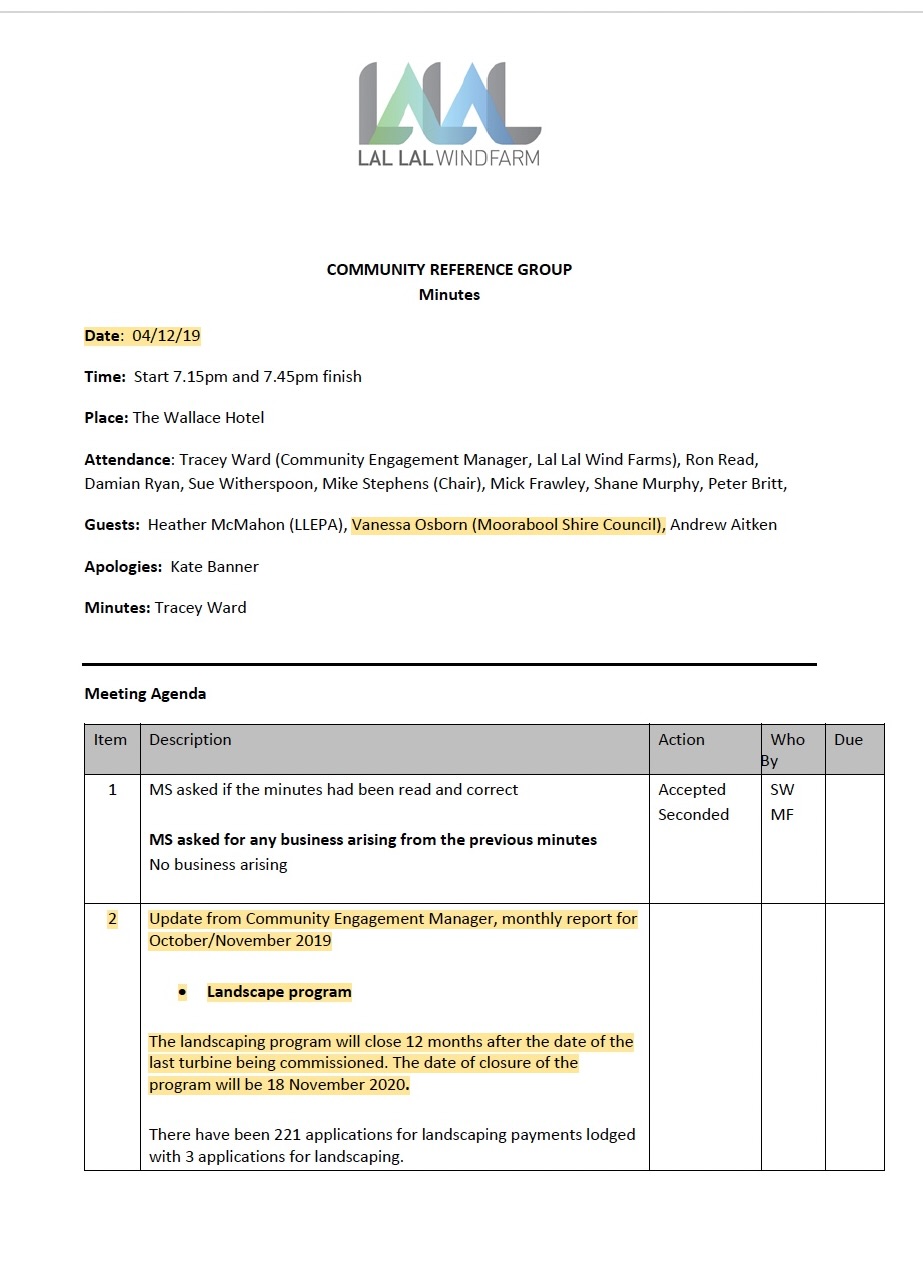
| Planning Permit PL-SP/05/0461 — Condition 12 | Twelve months after commissioning of the last turbine | The off-site landscaping program remained available until the end of that period. | The December 2019 CRG minutes and June 2020 Community Bulletin identify closure dates implying a final-turbine commissioning milestone of 18–19 November 2019. |
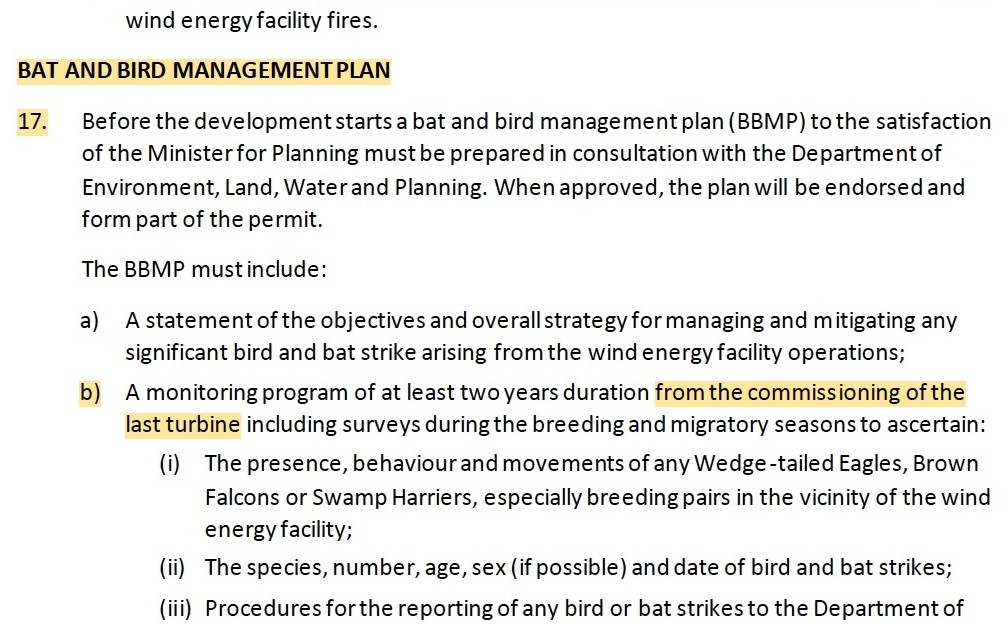
| Planning Permit PL-SP/05/0461 — Condition 17 | Commissioning of the last turbine | The endorsed bat and bird management pathway required monitoring and reporting by reference to the commissioning of the last turbine. | The disclosed correspondence records that the second and final annual bird and bat monitoring report was linked to the commissioning of the final turbine on 18 November 2019. The correspondence is preserved as evidence of the commissioning date used in administering that monitoring and reporting pathway. |
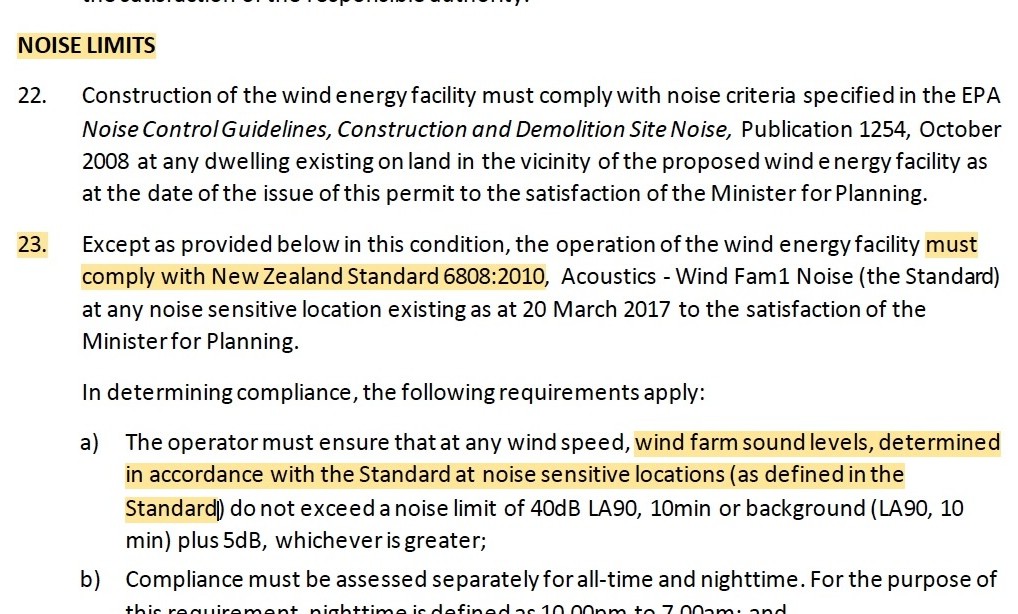
| Planning Permit PL-SP/05/0461 — Conditions 23–25 | Operational noise framework | The permit established the operational noise limits and required an endorsed Noise Compliance Testing Plan. | The detailed pathway is preserved through the permit, NCTP, Jacobs review, K15aa record and post-construction monitoring reports. |
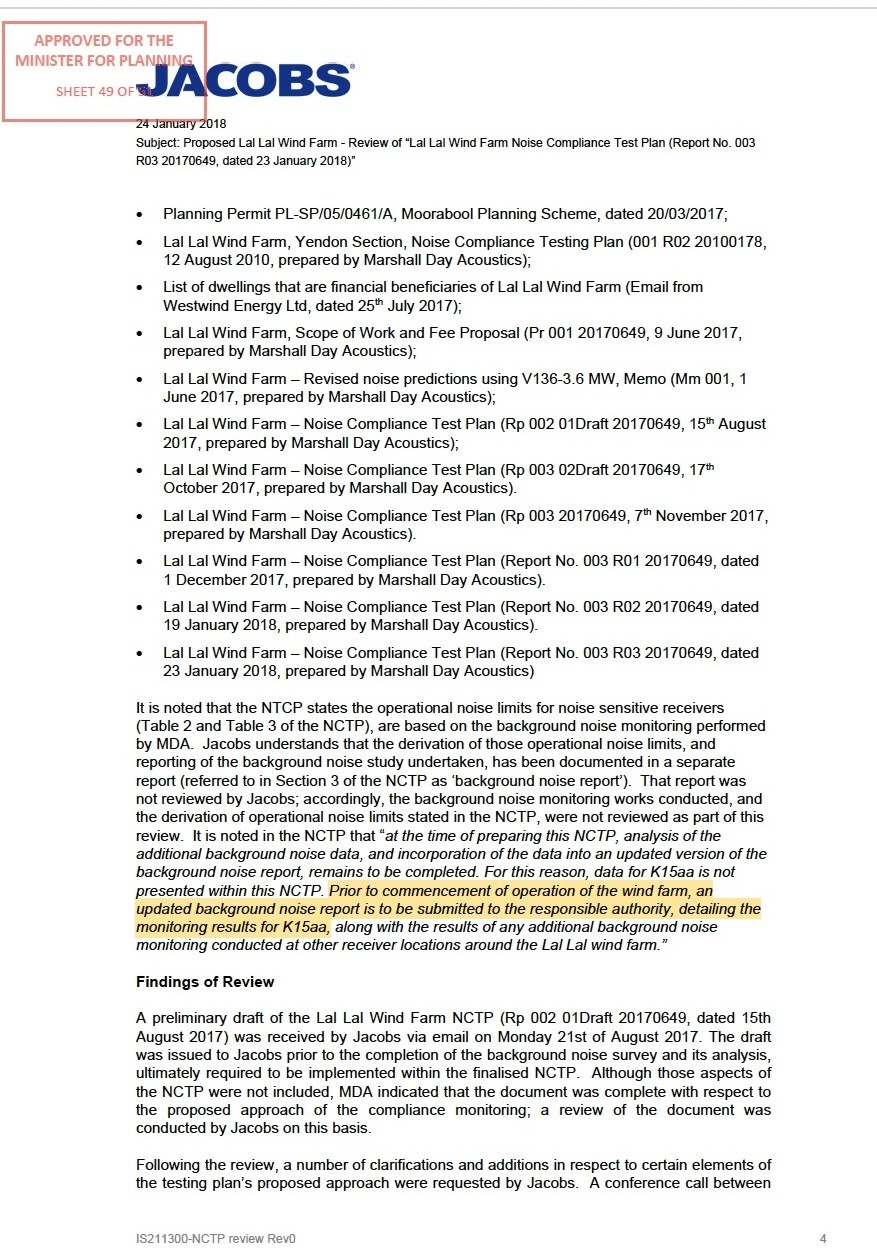
| Endorsed NCTP — updated K15aa report | “Prior to commencement of operation of the wind farm” | An updated background noise report detailing the K15aa monitoring results was to be submitted to the Responsible Authority. | The published K15aa report is dated 16 February 2021. The associated electricity-export, turbine-generation and 2019 monitoring chronology is examined below. |
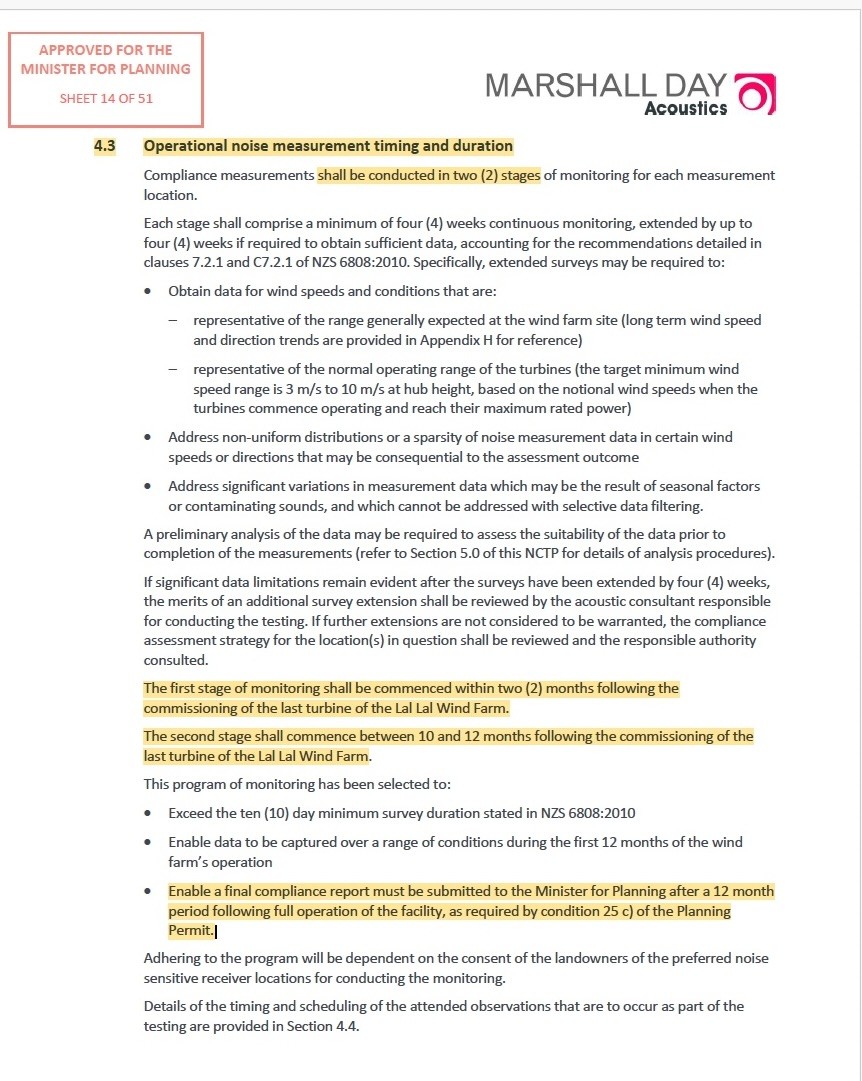
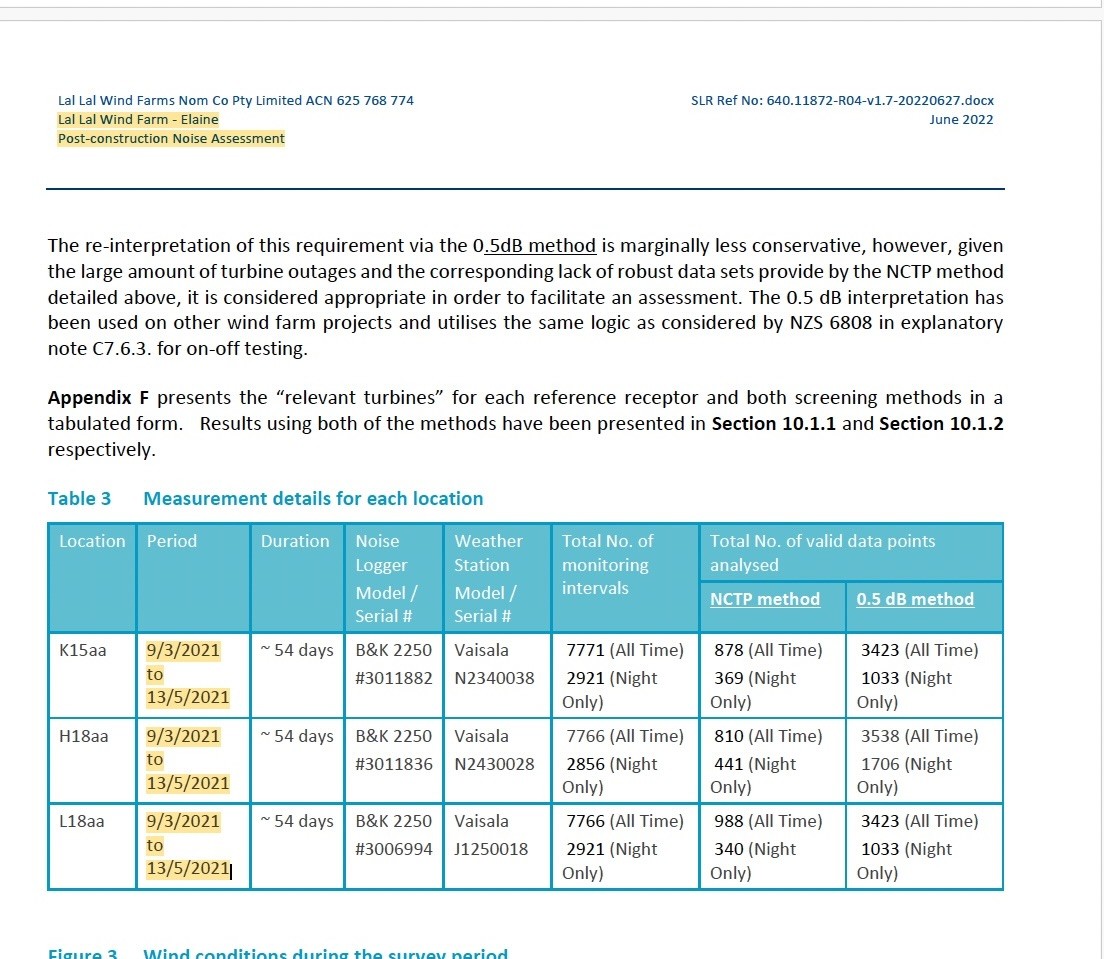
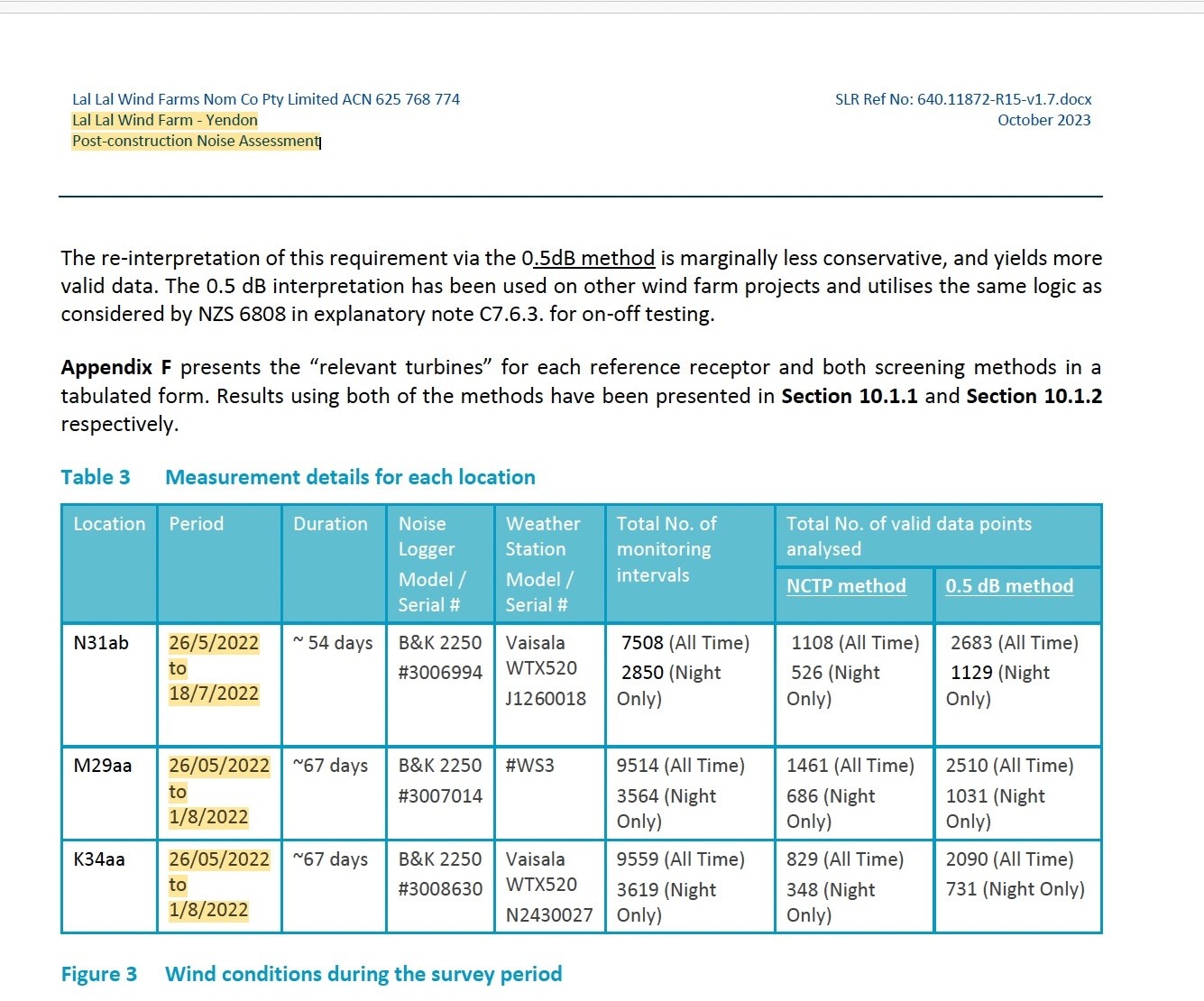
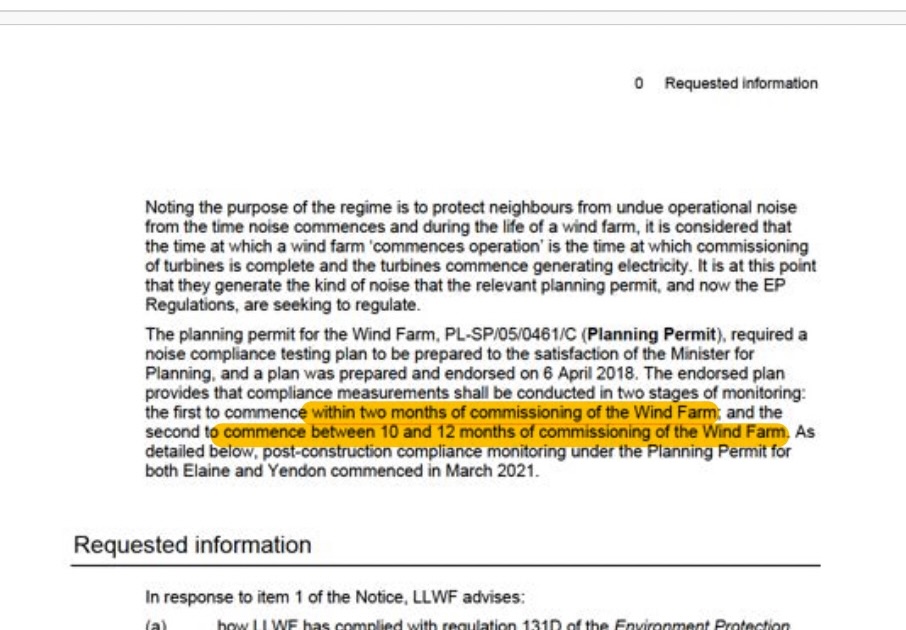
| Endorsed NCTP — Stage 1 | “The first stage of monitoring shall be commenced within two (2) months following the commissioning of the last turbine of the Lal Lal Wind Farm.” | Stage 1 operational monitoring was to commence within two months following commissioning of the last turbine. | Elaine monitoring was completed on 13 May 2021. Yendon monitoring was completed on 1 August 2022. |
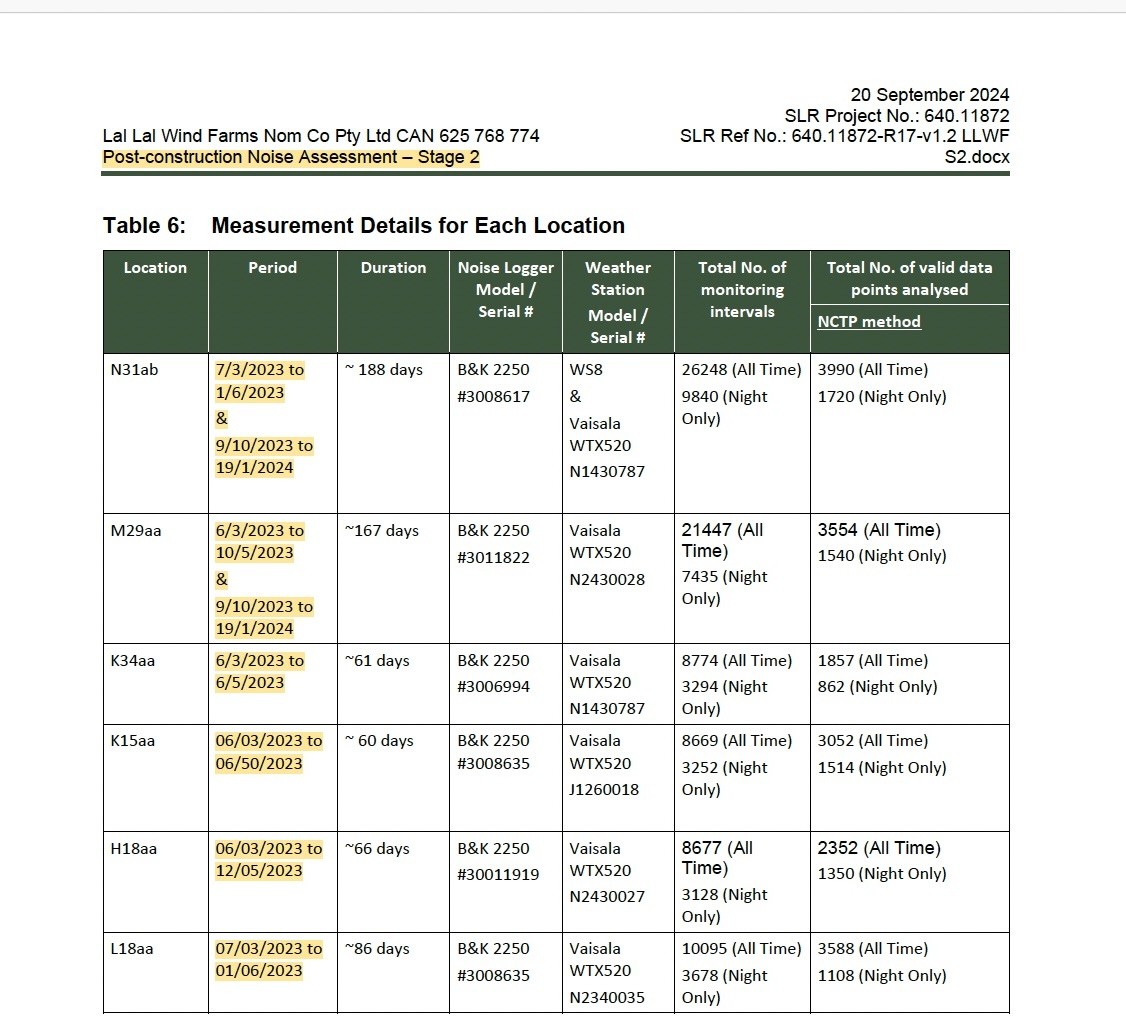
| Endorsed NCTP — Stage 2 | “The second stage shall commence between 10 and 12 months following the commissioning of the last turbine of the Lal Lal Wind Farm.” | Stage 2 operational monitoring was to commence between 10 and 12 months following commissioning of the last turbine. | Elaine Stage 2 monitoring was completed on 1 June 2023. Yendon Stage 2 monitoring was completed on 19 January 2024. The two dates are preserved separately. |
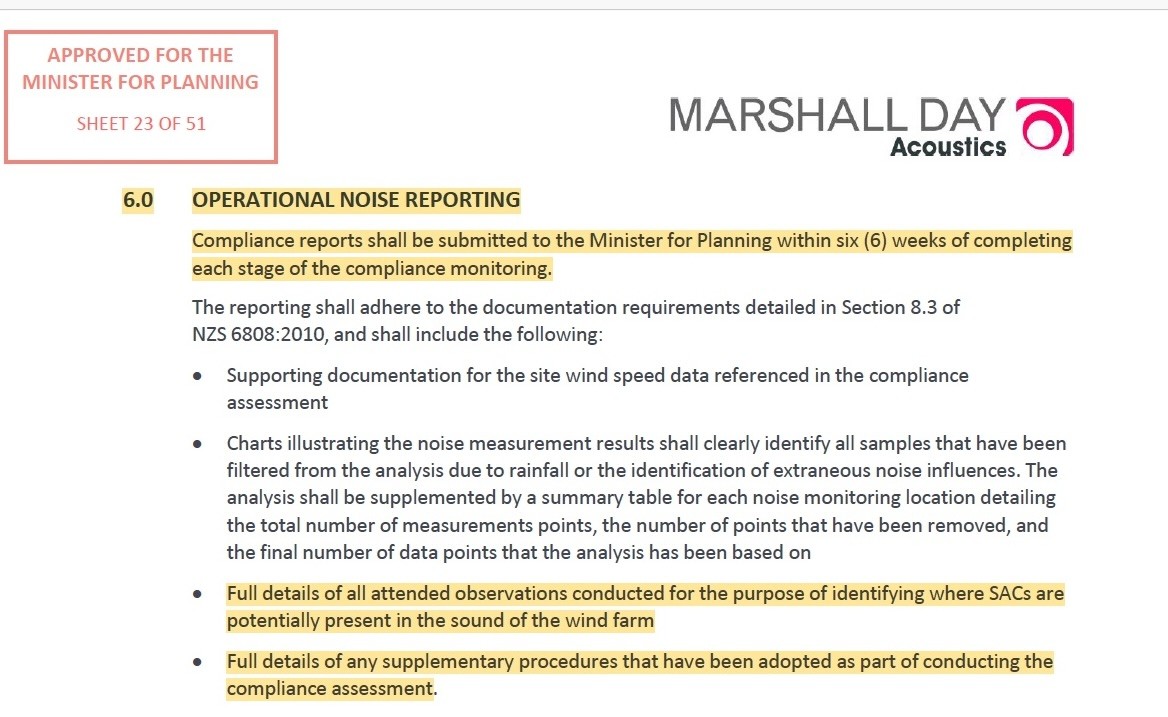
| Endorsed NCTP — section 6.0 | Completion of the monitoring undertaken for the relevant compliance stage | The corresponding compliance report was required to be submitted to the Minister for Planning within six weeks after that monitoring was completed. | The disclosed monitoring-completion dates may be compared with the dates appearing on the corresponding reports. The actual Ministerial submission dates remain dependent upon the administrative record. |
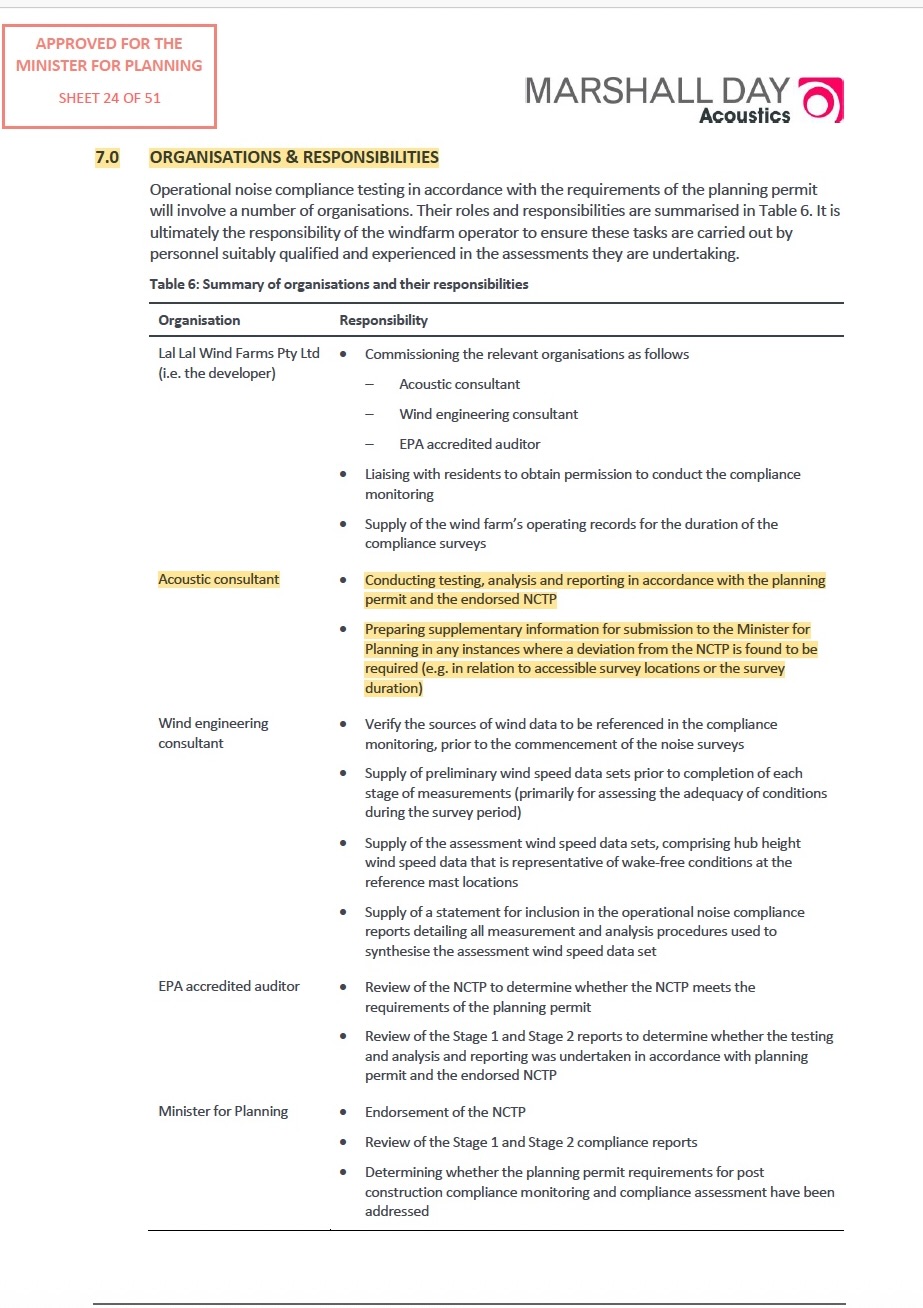
| Endorsed NCTP — section 7.0 | Each step in the endorsed testing and reporting pathway | The operator, acoustic consultant, wind engineering consultant, Environmental Auditor and Minister had identified responsibilities. | The responsibility table assists readers to identify which organisation prepared, reviewed, verified or received each part of the pathway. |
The permit, endorsed plan and source chronology
Each exhibit identifies its source document in the heading. The image provides a readable extract; the linked source document preserves the complete record.
Planning Permit triggers
Public commissioning chronology
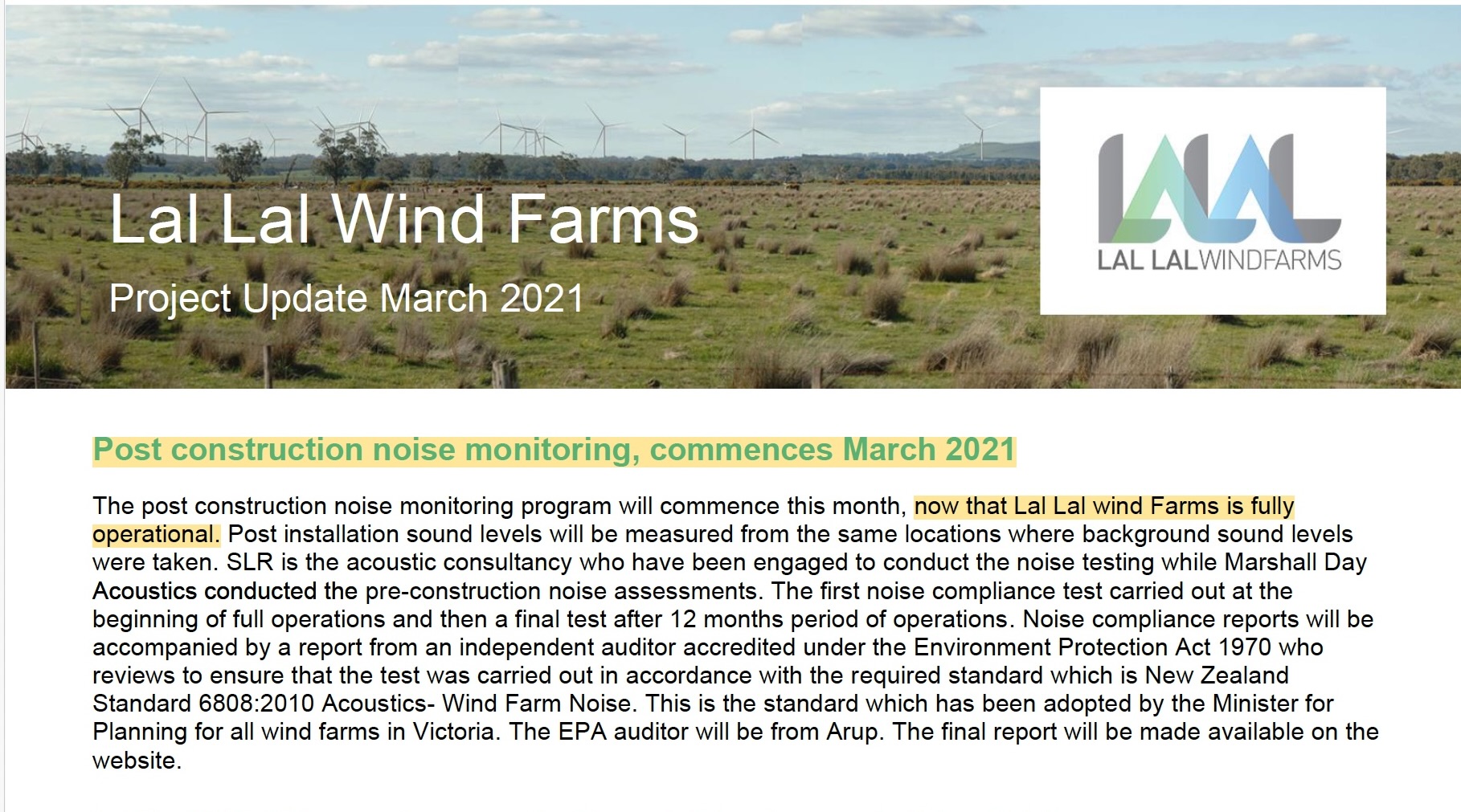
The following contemporaneous public records preserve the developing commissioning chronology from December 2019 through June 2020. The landscaping records identify an implied final-turbine milestone, while the March 2020 minutes record that the post-construction noise monitoring program was delayed because the wind farm was not operating at full capacity.
Community Reference Group chronology — post-construction noise monitoring
Following the 4 December 2019 Community Reference Group minutes, which linked the landscaping program to commissioning of the last turbine, subsequent Community Reference Group minutes preserved a contemporaneous administrative record concerning commencement of the post-construction noise monitoring program.
| 24 March 2020 | The post-construction noise monitoring program was delayed in commencing because Lal Lal Wind Farms was not operating at full capacity, with AEMO limiting the amount of generation. |
| 12 May 2020 | The post-construction noise monitoring program remained delayed because Lal Lal Wind Farms was not operating at full capacity. Operating levels recorded were 102 MW at Yendon at night, 42 MW during the day and 5 MW at Elaine, compared with total project capacity of 228 MW. |
| 8 September 2020 | The post-construction noise monitoring program remained delayed because Lal Lal Wind Farms was not operating at full capacity. |
| 12 November 2020 | The post-construction noise monitoring program remained delayed because Lal Lal Wind Farms was not operating at full capacity. |
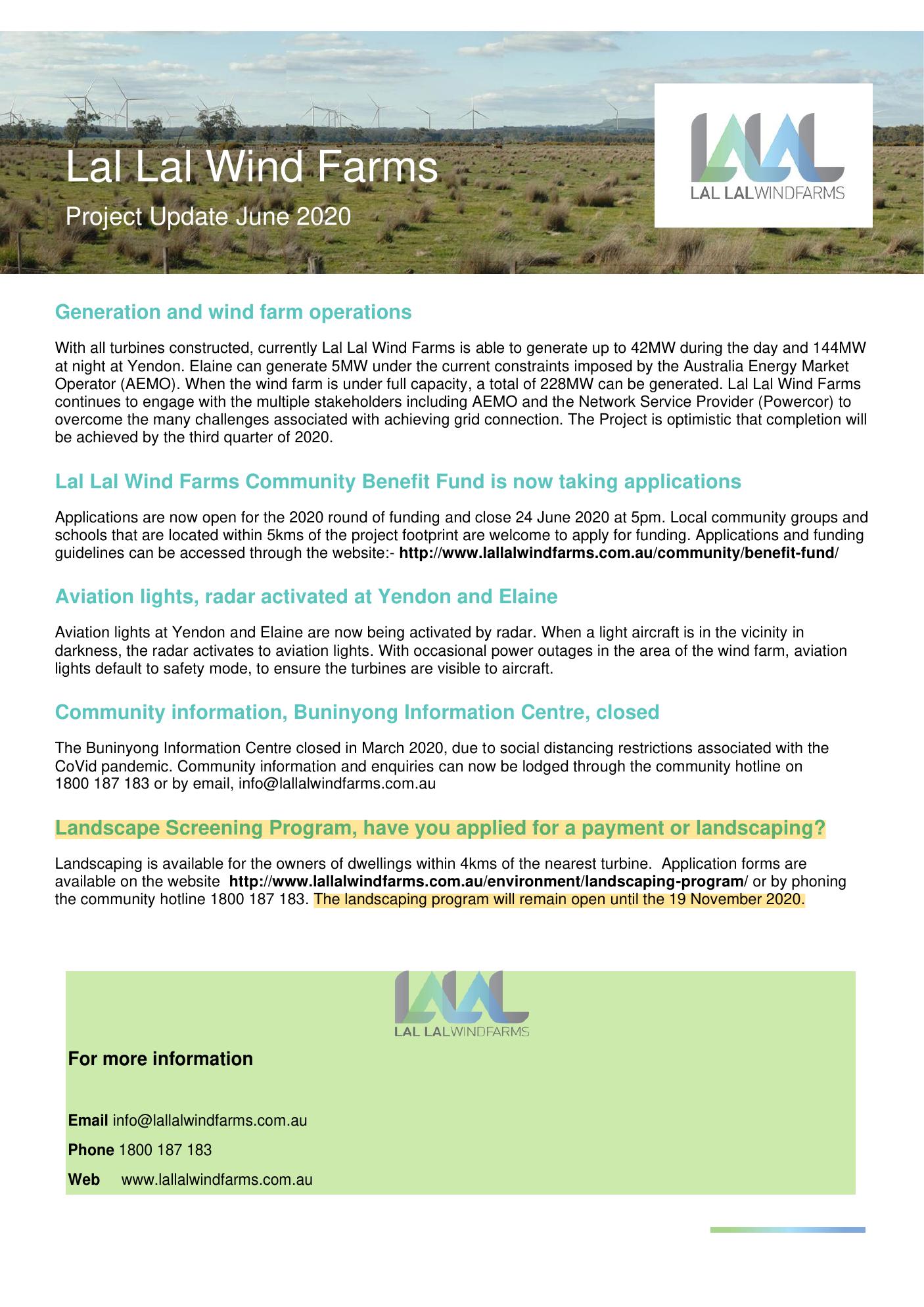
Other commissioning-linked monitoring record
Other documentary material records how the final-turbine commissioning milestone, and the related concept of commencement of operation, were used in administering monitoring and reporting pathways.
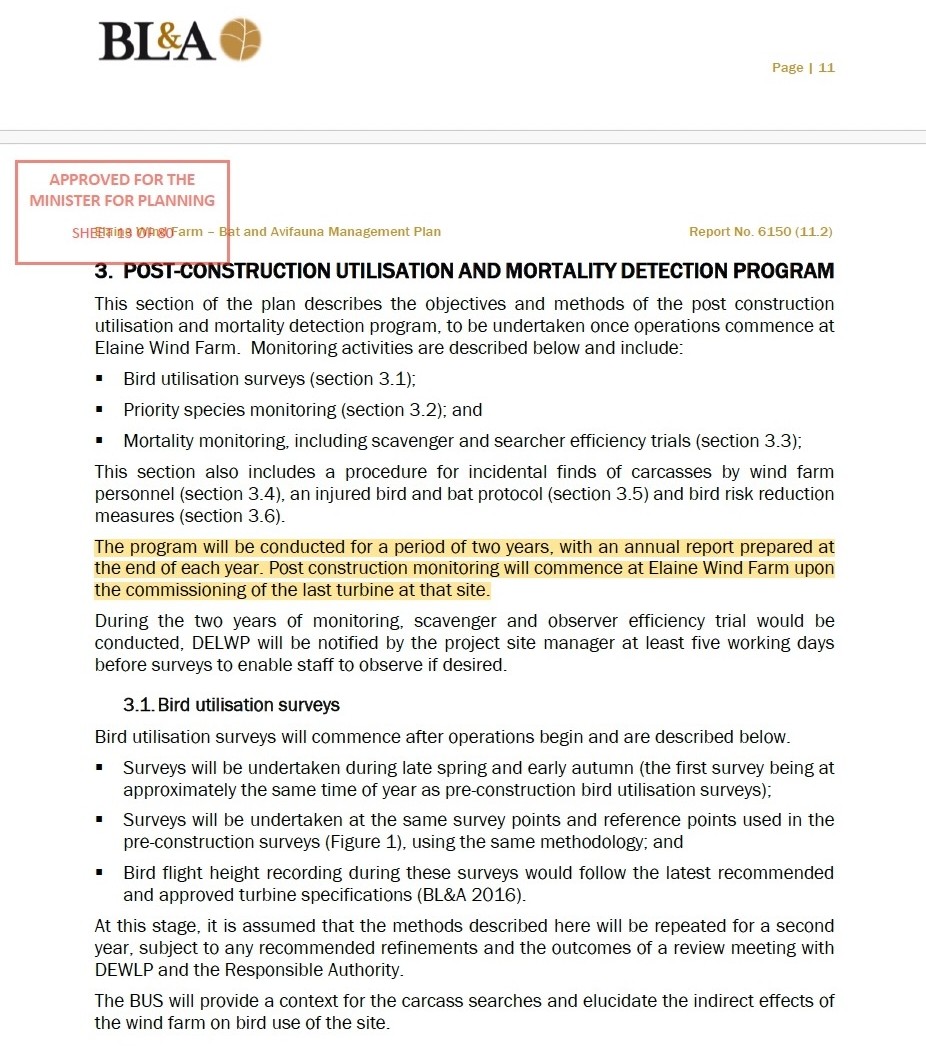
Operational noise framework and the K15aa pathway
Read in sequence, the endorsed NCTP records the applicable background-noise pathway and pre-operation requirement, the Jacobs review independently records that relationship, and SLR's later correspondence states how it regarded the K15aa baseline as having been established.
Noise sensitive location — definition incorporated by the permit
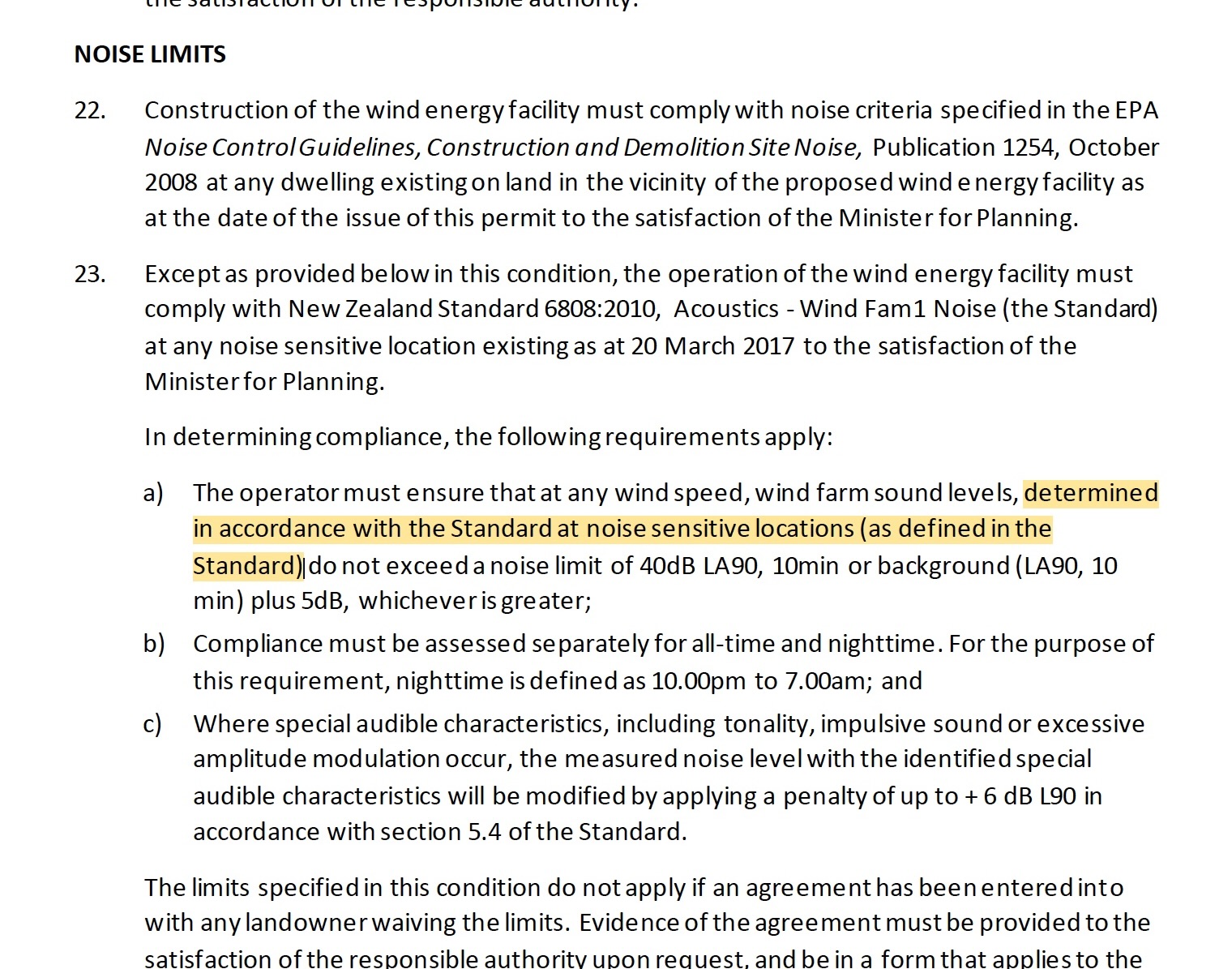
Condition 23 requires operation of the wind energy facility to comply with NZS 6808:2010 at any noise sensitive location existing as at 20 March 2017. In determining compliance, Condition 23(a) further requires wind farm sound levels to be “determined in accordance with the Standard at noise sensitive locations (as defined in the Standard)”.
NZS 6808:2010 defines “Noise sensitive location” as:
“The location of a noise sensitive activity, associated with a habitable space or education space in a building not on the wind farm site. Noise sensitive locations include:”
- (a) Any part of land zoned predominantly for residential use in a district plan;
- (b) Any point within the notional boundary of buildings containing spaces defined in (c) to (f);
- (c) Any habitable space in a residential building including rest homes or groups of buildings for the elderly or people with disabilities, papakainga and marae, excluding habitable spaces in buildings where the predominant activity is commercial or industrial. (Residential buildings designed for permanent habitation on land zoned for predominantly rural or rural-residential use are not classified as commercial or industrial for the purposes of this Standard);
- (d) Teaching areas and sleeping rooms in educational institutions, including public and private primary, intermediate, and secondary schools, universities, polytechnics, and other tertiary institutions;
- (e) Teaching areas and sleeping rooms in buildings used for licensed kindergartens, childcare, and day-care centres; and
- (f) Temporary accommodation including in hotels, motels, hostels, halls of residence, boarding houses, and guest houses.
The Standard separately defines Notional boundary as: “A line 20 metres from any side of a dwelling or other building used for a noise sensitive activity, or the legal boundary where this is closer to such a building.”
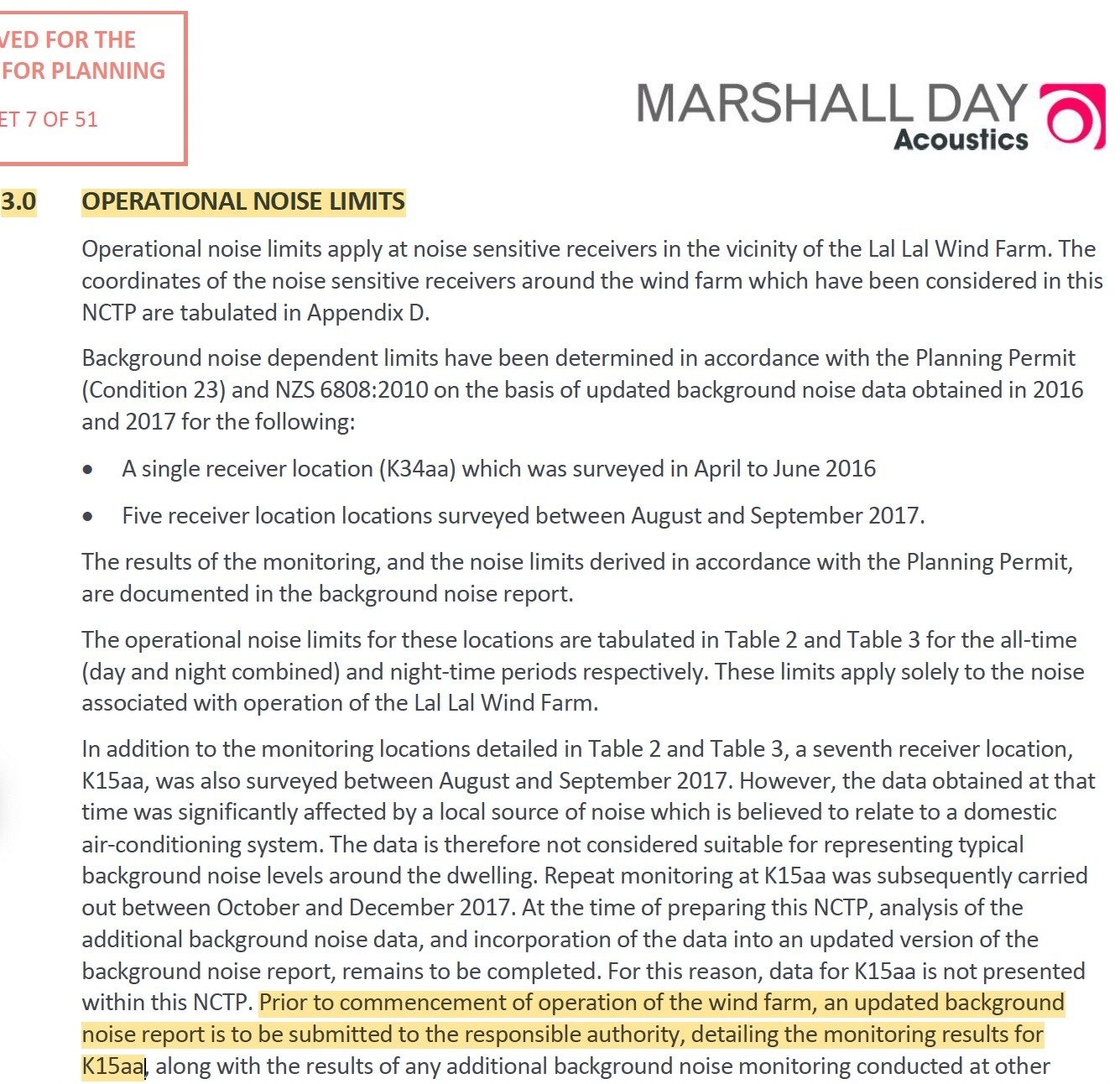
Commencement-of-operation record
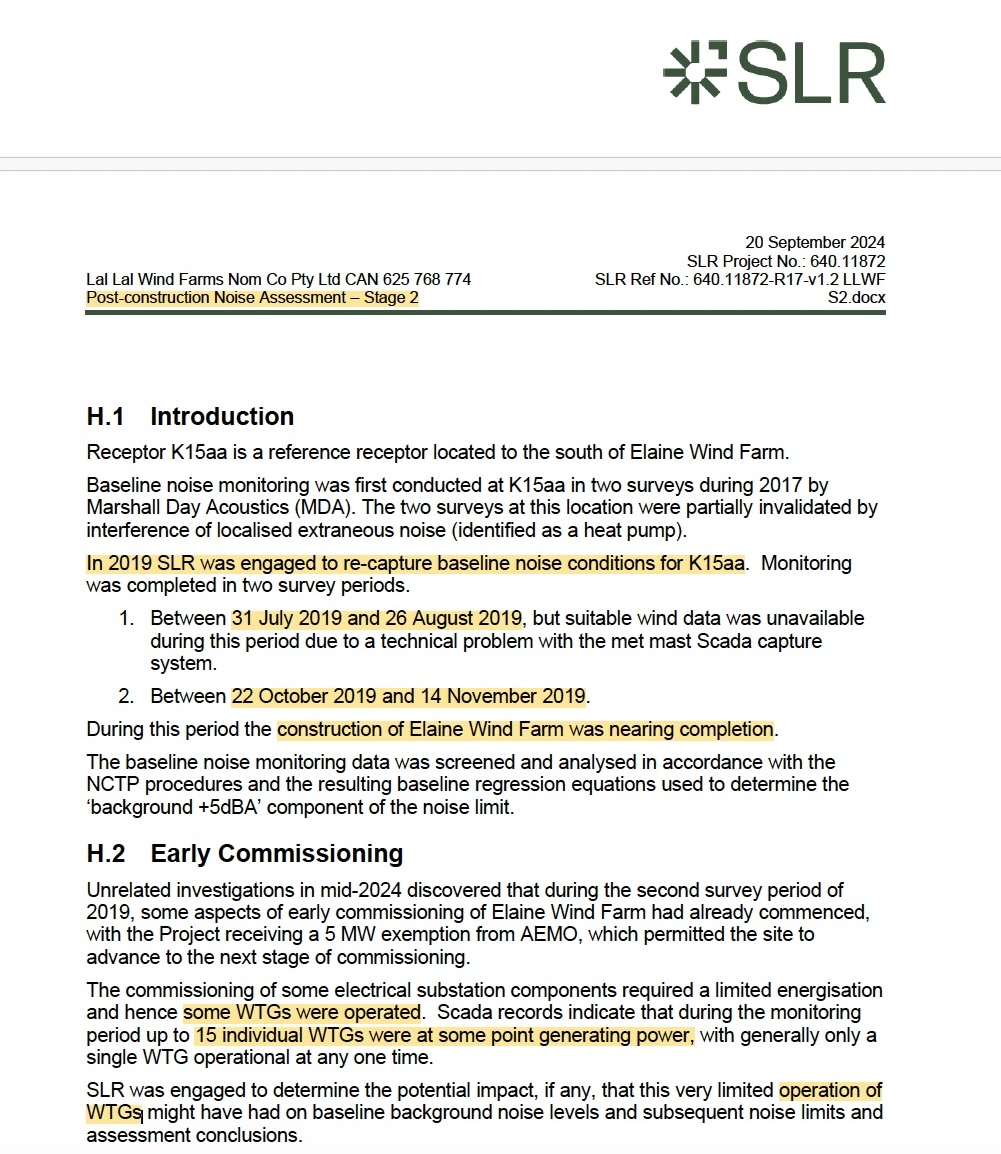
The documentary record contains separate descriptions of background sound, limited turbine operation during the 2019 K15aa monitoring program and commencement of operation. These records are presented together for documentary reconciliation and are not treated here as determining technical compliance.
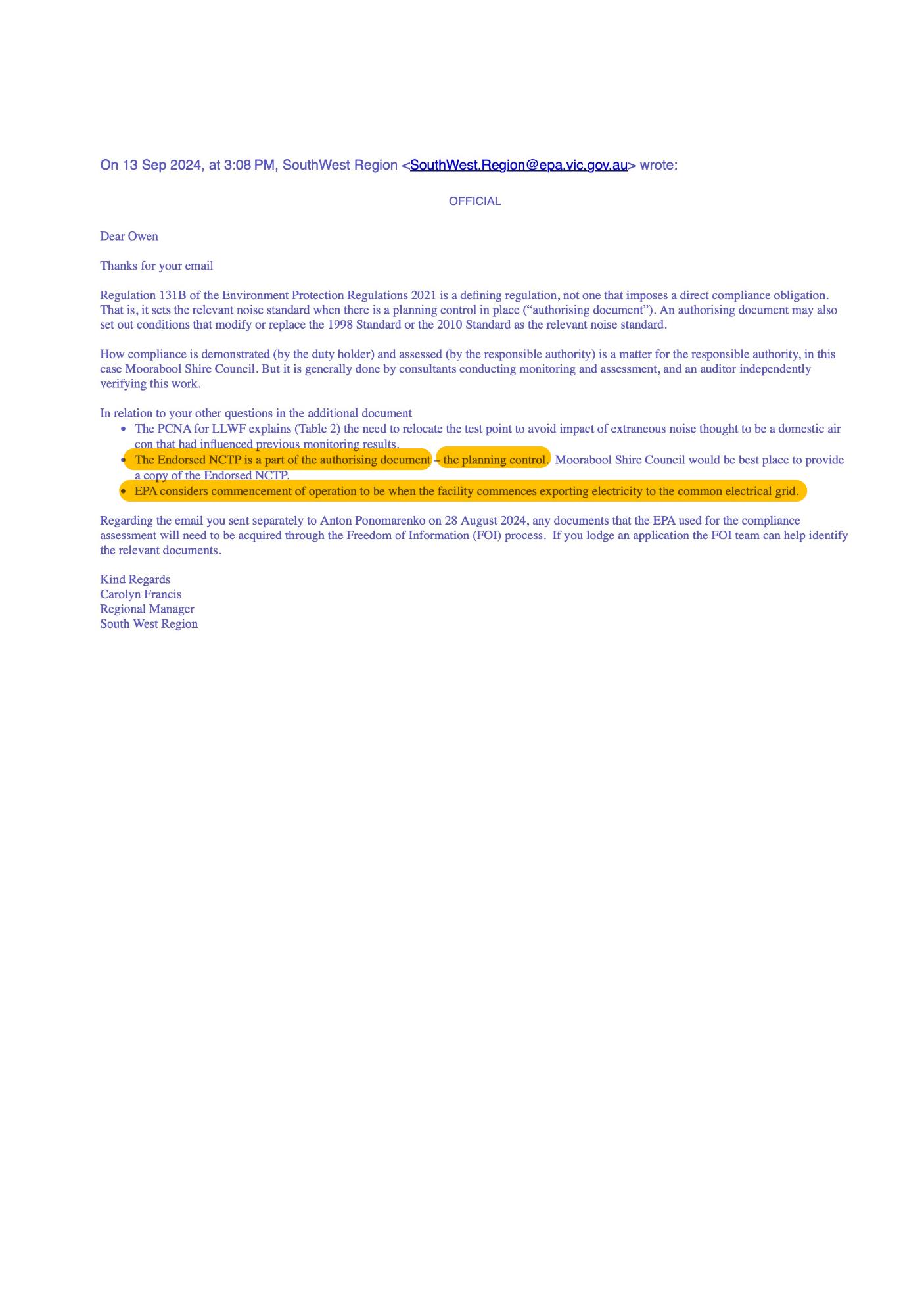
The Appendix H chronology is to be read together with the NZS 6808:2010 definition of background sound:
“Background sound — The A-frequency-weighted L90 centile level measured prior to the installation of any wind turbines in an area.”
Together, the records preserve three distinct concepts: the Standard's definition of background sound, EPA's administrative position on commencement of operation, and SLR's recorded chronology of turbine operation and generation during the 2019 K15aa monitoring program.
EPA FOI-100-2025. In the Beneficiary's historical EPA FOI request, the Lal Lal Wind Farm Compliance Baseline Monitoring Report 640.11872-R01 v1.1 dated February 2021 was expressly requested. EPA's decision identified nine responsive documents, but the scheduled documents did not include that foundational K15aa report, and the decision did not separately address whether the report was held or why it was not provided.
DTP FOI CS015467. The Beneficiary also requested the date on which the SLR Lal Lal Wind Farm Compliance Baseline Noise Monitoring Report 640.11872-R01 dated February 2021 was submitted to the Department, Minister or Responsible Authority. In its decision dated 1 October 2024, the Department of Transport and Planning advised that extensive searches located no information relevant to the request and that it appeared no relevant documents had been submitted to the Department.
NCTP post-construction monitoring stages
The NCTP uses commissioning of the final turbine as the trigger for both mandatory post-construction monitoring stages. The disclosed Elaine and Yendon completion dates are preserved separately.
NCTP section 6.0 reporting chronology
Section 6.0 starts the reporting period when the monitoring undertaken for the relevant compliance stage is completed. The corresponding compliance report was required to be submitted to the Minister for Planning within six weeks after that monitoring was completed.
Documentary comparison of reporting timeframes
The disclosed monitoring-completion dates are compared with the corresponding six-week dates and the dates appearing on the reports. The elapsed intervals below are calculated from the documentary dates and do not, by themselves, establish the dates of actual submission to the Minister.
Conflicting commissioning and operational-status record
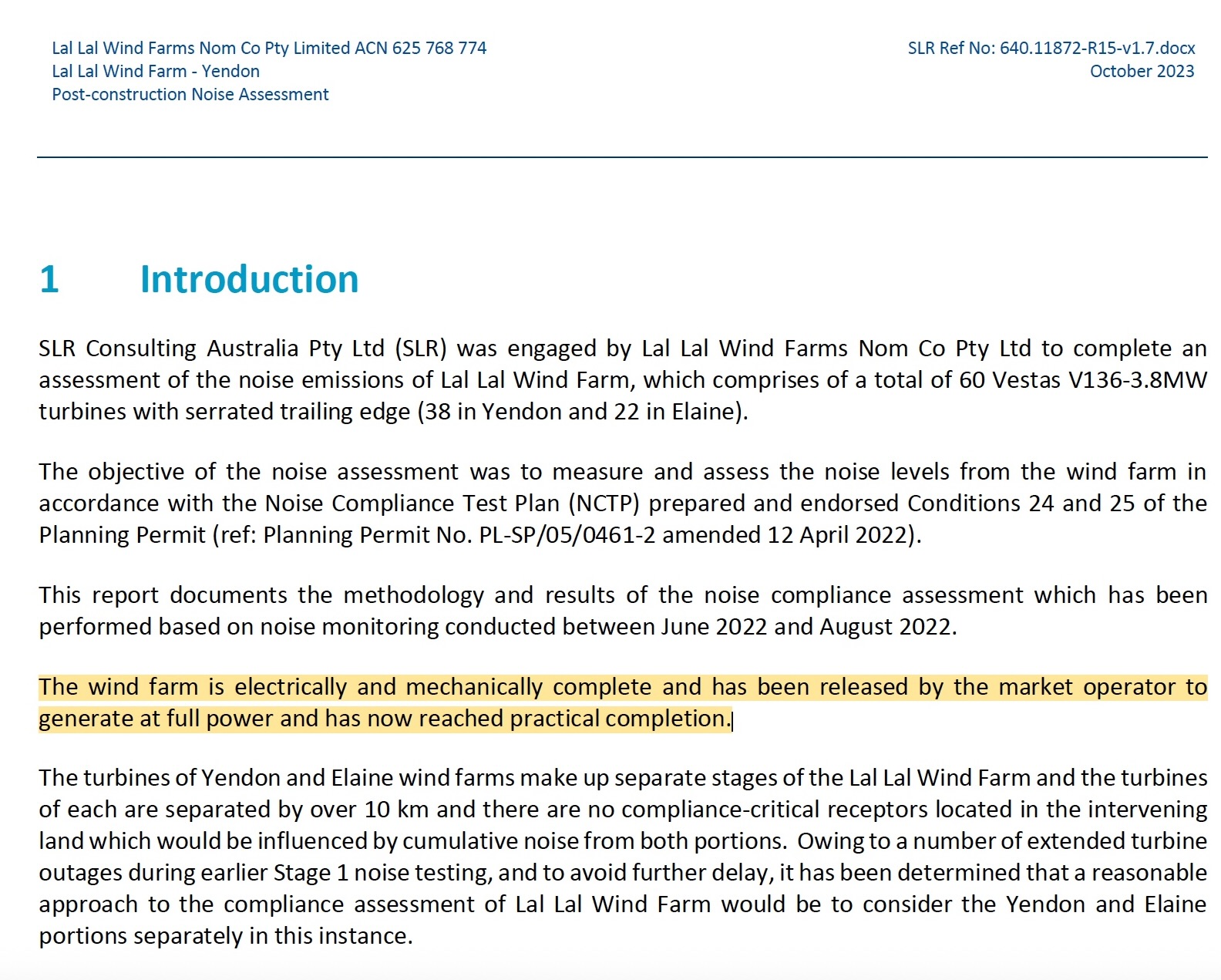
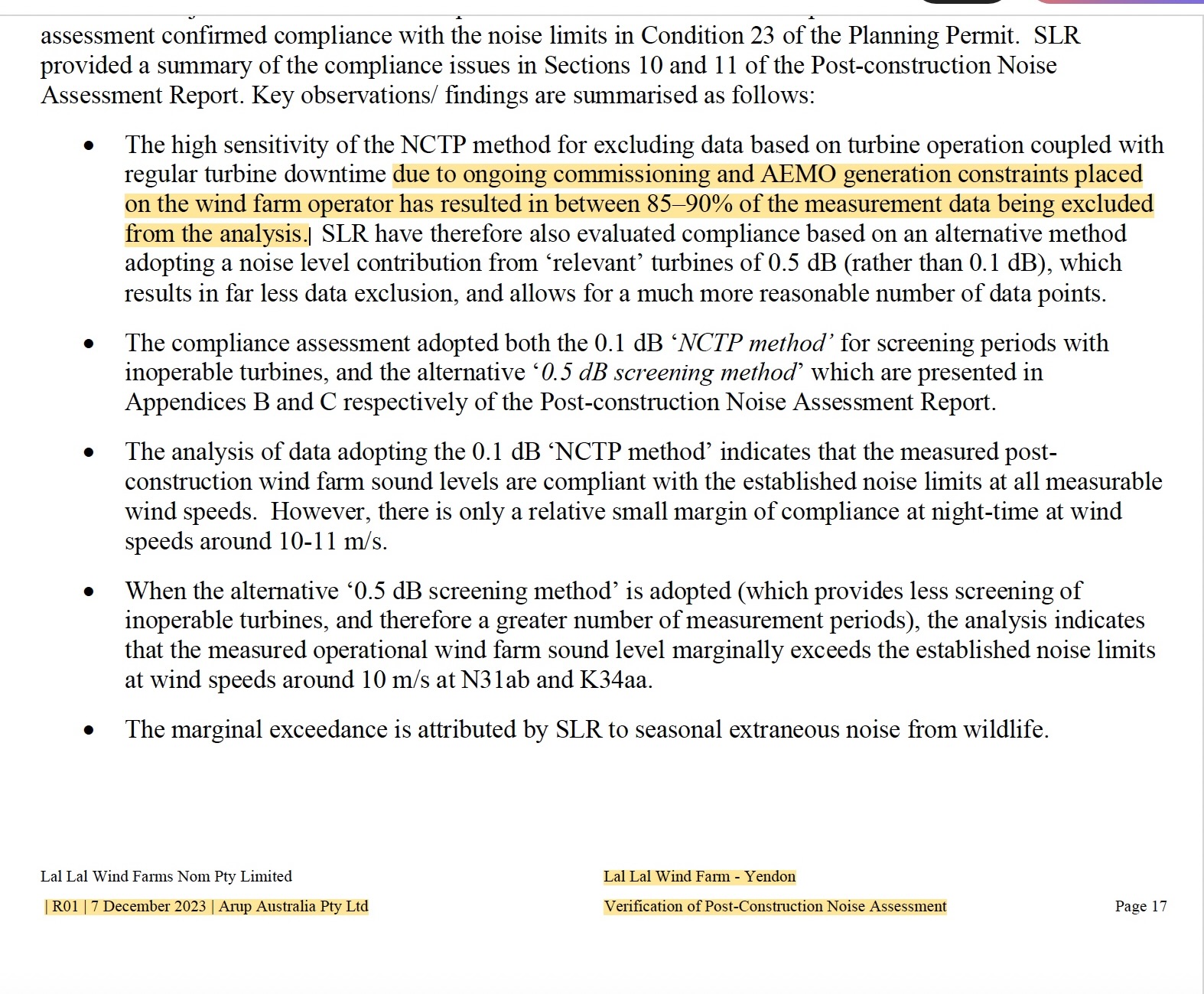
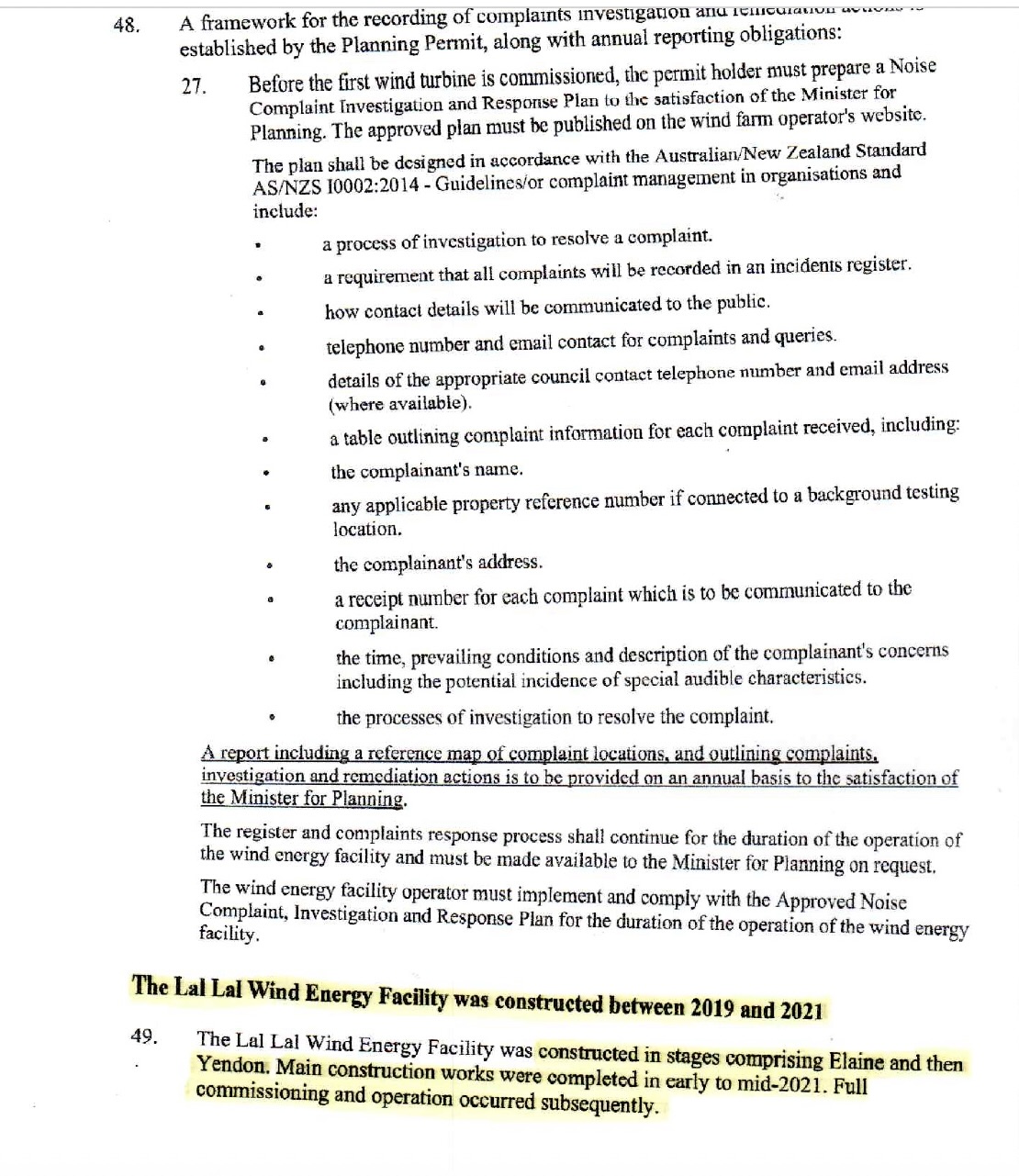
The disclosed record uses several different dates and project-status expressions: final-turbine commissioning, completion of commissioning, commencement of operation, release to full output, practical completion and later references to ongoing commissioning. The records below are presented together because the endorsed NCTP uses commissioning of the last turbine as a mandatory timing trigger. The page does not assume that these expressions are interchangeable.
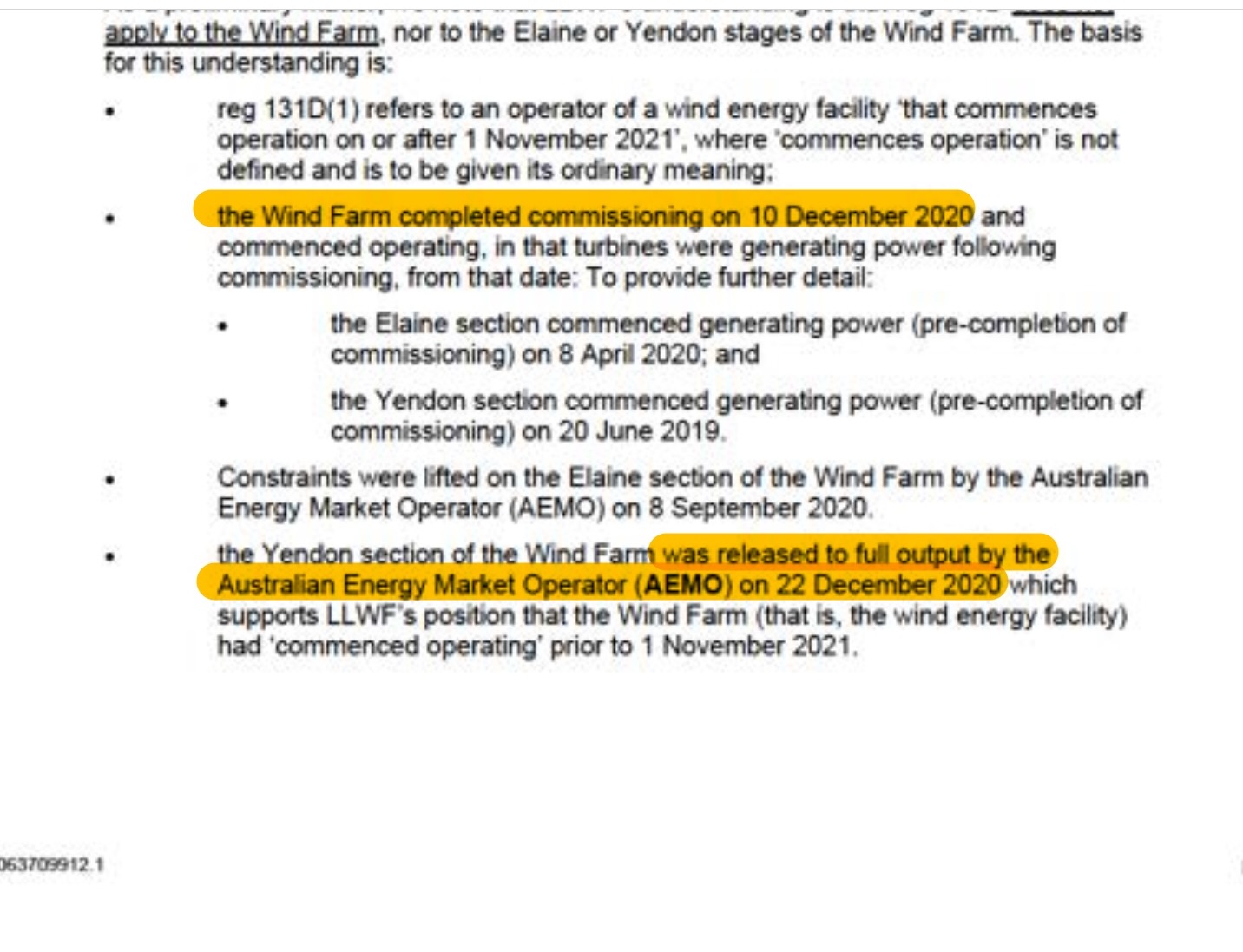
Commissioning-related descriptions in the disclosed record
| Record | Date or status recorded | Documentary significance |
|---|---|---|
| CRG / landscaping record | Closure dates imply final-turbine commissioning around 18–19 November 2019. | The date is inferred from a permit-linked 12-month landscaping period; no formal commissioning certificate was located in the later Council FOI record. |
| LLWF response to EPA IGN-00008382 | Commissioning completed 10 December 2020; Yendon released to full output 22 December 2020. | The operator expressly distinguishes completion of commissioning from earlier generation and the later full-output release. |
| LLWF Practice Day Submissions — VCAT P775/2023 | Main construction completed in early to mid-2021; “Full commissioning and operation occurred subsequently.” | This is a statement in the Permit Holder's submissions, not a VCAT finding, and it describes a later commissioning/operation sequence than the 2020 IGN date. |
| SLR Yendon report — October 2023 | Wind farm described as electrically and mechanically complete, released to generate at full power and having reached practical completion. | The report records project status but does not identify the date on which those milestones occurred. |
| ARUP Yendon verification — 7 December 2023 | Records regular turbine downtime due to “ongoing commissioning and AEMO generation constraints” as part of the explanation for 85–90% data exclusion. | The wording appears in the auditor's summary of the Yendon assessment and is preserved without treating “ongoing commissioning” as automatically equivalent to the NCTP's “commissioning of the last turbine”. |
Different concepts
Generation, release to full output, commissioning completion, full commissioning, practical completion and final-turbine commissioning are separately described in the disclosed record.
NCTP trigger
The endorsed NCTP does not simply use “project completion”. It requires Stage 1 and Stage 2 monitoring by reference to commissioning of the last turbine of the Lal Lal Wind Farm.
Question left by the record
Which commissioning event and date was actually used to administer the NCTP's mandatory two-month and 10–12-month monitoring windows?
Trustee enquiry seeking the commissioning completion record
After identifying the later operator statement that the wind farm completed commissioning on 10 December 2020 and commenced operating from that date, the Trustee asked Lal Lal Wind Farm for the commissioning certificate or equivalent commissioning-completion document for the final turbine. The enquiry expressly stated that it was made for administrative record purposes only and that no allegation was made.
Follow-up and documentary status. After no acknowledgement had been received, the Trustee sent a follow-up dated 4 March 2026 seeking confirmation that the enquiry had been received and recorded in the Enquiries and Complaints Register in accordance with the published Community Engagement Policy and Complaints and Enquiries Procedure.
Documents supporting this page
The disclosed sources do not use one uniform date
The present record includes public material implying final-turbine commissioning on 18–19 November 2019; the operator's later statement that commissioning was completed on 10 December 2020 and Yendon was released to full output on 22 December 2020; the Permit Holder's VCAT submission that main construction continued into early to mid-2021 and full commissioning and operation occurred subsequently; SLR's later practical-completion description; and ARUP's reference to ongoing commissioning in the Yendon assessment. The repository preserves each source and the status concept it uses rather than treating these expressions as automatically synonymous.