
Noise Compliance Testing Plan
The Noise Compliance Testing Plan (NCTP) is the endorsed methodology required under the Planning Permit for the post-construction assessment of operational wind farm noise. It establishes the mandatory assessment framework against which post-construction compliance monitoring and reporting are undertaken.
Why the NCTP was considered important
During the Public Information Session, SLR acoustician Gustaf Reutersward explained that the Noise Compliance Testing Plan establishes the methodology used for post-construction compliance assessment. His explanation reinforces the central role of the NCTP within the assessment framework presented throughout this record.
The following video excerpt is reproduced as part of the documentary record. It records SLR’s public explanation of the role of the NCTP in establishing the methodology for post-construction compliance assessment.
Public explanation of the missing K15aa limit and later SLR monitoring
In the same public presentation, SLR acoustician Gustaf Reuterswärd addressed the operational noise limits in the endorsed NCTP. The presentation records that the NCTP did not include a noise limit for reference location K15aa and that K15aa was subsequently monitored, with an appropriate limit derived by SLR.
Why the NCTP matters
The NCTP was approved as part of the permit framework. It records how operational wind farm noise was to be measured, assessed and reported. For this record, the NCTP is read as the practical method by which the planning permit and NZS 6808 framework were to be applied.
Requirement
The NCTP identifies locations, data requirements, operational measurement rules, special audible characteristic procedures and reporting steps.
Record
Later technical reports and agency records are read against the NCTP to ask whether the required pathway can be followed from the disclosed documents.
Verification
The NCTP is central to the Documentary Verification method because it connects mandatory requirements to the source record.
Where the NCTP sits in the governing hierarchy
The NCTP does not sit alone. It is part of the same pathway used across this record.
Read the NCTP with the pre-construction assessments
The NCTP is the endorsed post-construction compliance methodology. The earlier planning-stage and pre-construction acoustic assessments explain the predictive and background material that preceded the operational testing pathway.
NCTP requirements highlighted
Where the approved NCTP uses mandatory language, this record preserves that language and asks whether the later disclosed record enables independent reconciliation.
| Area | Mandatory pathway | Documentary question |
|---|---|---|
| K15aa | The endorsed NCTP requires an updated K15aa background noise report prior to commencement of operation. That report forms part of the NZS 6808:2010 background-sound pathway from which operational noise limits for the relevant reference-receptor group are derived. | Whether the disclosed record demonstrates that the required background sound was established in accordance with NZS 6808:2010, that the operational noise limits were derived from that dataset, and that the completed report entered the Responsible Authority and wider agency custody record. |
| Measurement locations | The NCTP identifies preferred operational measurement locations and the circumstances in which alternative locations may be used. These requirements form part of the endorsed project methodology through which NZS 6808:2010 is applied within the Planning Permit framework. | Whether the operational measurements can be traced to the approved reference locations and whether any departure, substitution or alternative location is supported by the NCTP methodology and the disclosed authorising and administrative record. |
| Measurement position | The NCTP requires operational measurements to be undertaken within the applicable dwelling-proximity and notional-boundary pathway and, where practicable, as close as possible to the background monitoring position. This preserves the intended relationship between the background dataset and the later operational assessment. | Whether continuity can be demonstrated between the original background monitoring position, the operational measurement position and the approved NZS 6808:2010 and NCTP location methodology. |
| Acoustic and wind data | The NCTP specifies the acoustic measurements and synchronised wind data required for the post-construction assessment, including the data relationships needed to derive and test operational noise results under the approved NZS 6808:2010 pathway. | Whether the disclosed acoustic and meteorological datasets, exclusions, correlations and assessment inputs allow the compliance analysis and resulting conclusions to be independently followed through the source record. |
| Special Audible Characteristics | The NCTP contains mandatory procedures for identifying, observing and assessing Special Audible Characteristics (SAC) during post-construction compliance monitoring, including the attended-observation gateway and any further objective assessment required by the approved methodology. | Whether the disclosed record demonstrates that attended observations, monitoring periods, character assessment, reporting and any applicable adjustment were completed in accordance with the NCTP and NZS 6808:2010 pathway, and whether the evidentiary record is complete. |
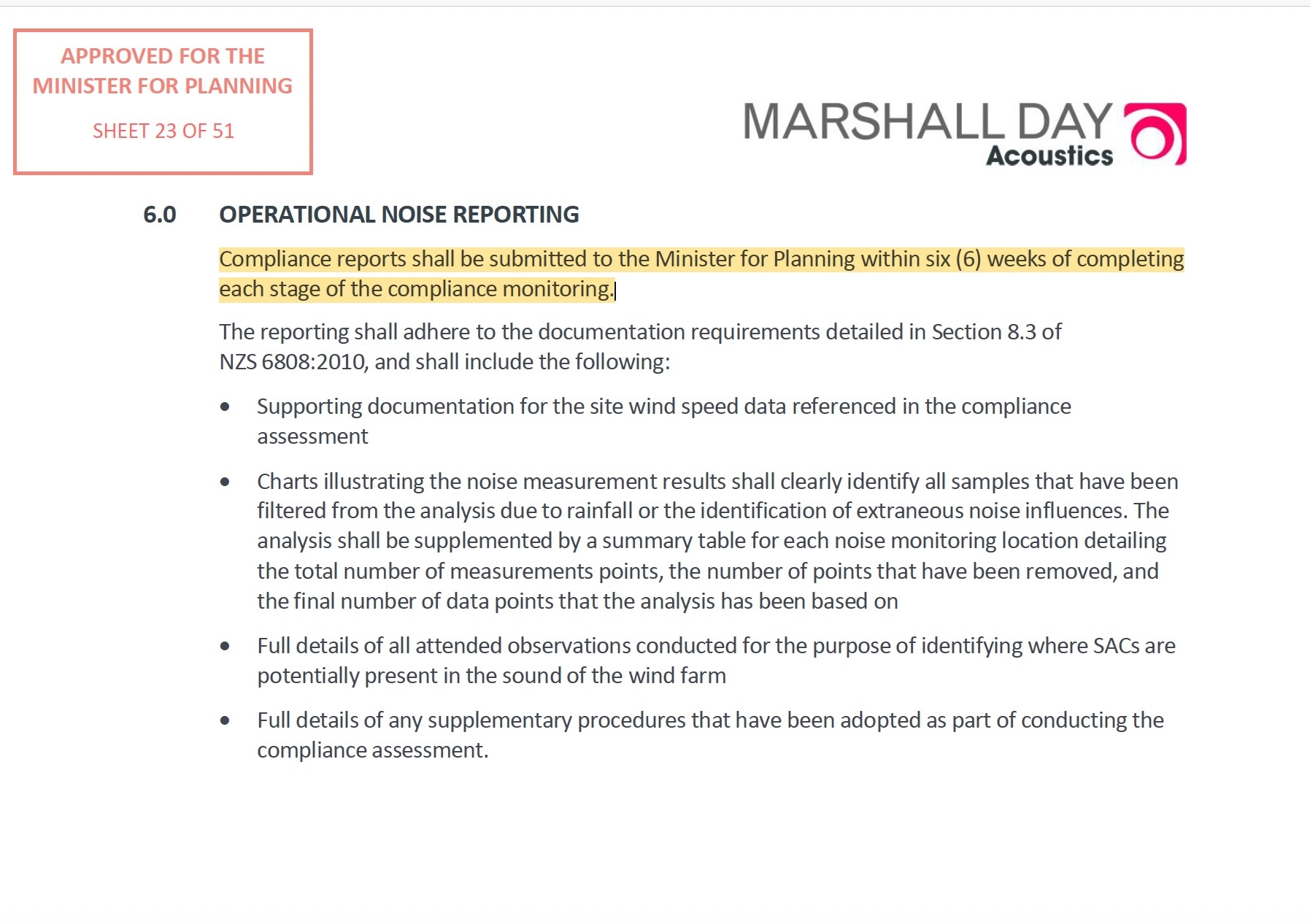
| Reporting | The NCTP establishes mandatory reporting requirements following completion of each stage of compliance monitoring, including submission of the resulting compliance report within the approved Planning Permit pathway. | What was reported, when each monitoring stage was completed, whether the applicable reporting timeframe was met, and whether the resulting reports can be reconciled with the Responsible Authority and wider agency custody record. |
Monitoring duration and mandatory reporting
During the SLR Public Information Session – Methodology explanation (commencing at 44:30), Gustaf Reutersward explained that post-construction monitoring campaigns may extend over an extended period because sufficient valid data must be obtained under representative operating and environmental conditions before the assessment can be completed. He also explained that attended listening observations form the "gateway" to further objective analysis.
The approved Noise Compliance Testing Plan (NCTP) separately establishes the mandatory reporting requirement that follows completion of each stage of compliance monitoring.
DTP: monitoring methodology is set out in NZS 6808:2010
In a 12 August 2026 response later supplied to the Beneficiary by a third party, DTP stated that the monitoring methodology is set out in NZS 6808:2010 and that the Victorian Guideline does not supplement the requirements of Clause 52.32 and NZS 6808:2010.
The NCTP is used as a verification map
The record does not use the NCTP to make its own compliance finding. It uses the NCTP to identify the required steps and then asks whether those steps can be followed in the disclosed record.
Primary documents and further reading
This page is a guide. The detailed record remains in the executed documents and source material.
Agency Records
The record includes a public gateway to the documentary records of EPA Victoria, the Department of Transport and Planning, Moorabool Shire Council and the Australian Energy Infrastructure Commissioner. Agency pages present the correspondence, Freedom of Information material and source documents currently available within the record.
NCTP and October 2022 NMP measurement locations
The endorsed NCTP identifies six preferred operational measurement locations: H18aa, K15aa, K34aa, L18aa, M29aa and N31ab. The October 2022 NMP identifies H18aa, K15aa and L18aa as preferred compliance measurement locations. The NMP separately states that the NCTP takes precedence where a conflict exists.