
Y1
Yendon Stage 1
Monitoring chronology, report-status record, attended observations and frog/rainfall comparison.
A guided pathway through the technical documents that underpin the Lal Lal Wind Farm administrative and evidentiary record.
Technical reports do not exist independently of one another. Earlier reports establish assumptions, monitoring methods and baseline information that later reports may rely upon, verify or revisit. Understanding the order in which reports were prepared helps readers understand the documentary record.
This page helps readers understand how the technical record developed. It does not replace the source documents, the Glossary, or the evidence pages. It shows how the technical reports fit together before readers move into detailed issues such as K15aa, NCTP, NZS 6808 and SAC.
Follow the planning-stage acoustic record through Marshall Day background monitoring, the April 2018 Sonus prediction, AECOM Environmental Auditor peer review and the now-published June 2018 Sonus assessment S5464C11. The pathway also distinguishes later EPA, SLR and ARUP references from the formal PCNA and Environmental Auditor verification record, which identifies the Marshall Day/NCTP pathway.
Follow the Yendon Stage 1 record through the 2021 monitoring attempts, the 26 October 2021 CRG report-status statement, the later 2022 monitoring campaign, the final SLR assessment, the attended-observation record and the frog-noise / rainfall comparison.
The technical record is not a set of isolated PDFs. Each document sits within a governing pathway that begins with the Planning Permit, passes through NZS 6808:2010 and the Noise Compliance Testing Plan, and then moves into background sound, post-construction assessment, auditor review, later technical response and disclosure records.
The following chronology preserves the existing technical content but places it into the glossary-led learning pathway now used across the record.
Original background monitoring and the K15aa monitoring history that led to supplementary monitoring.
September 2019 operational record following the Yendon turbine-blade incident.
1 October 2019 project-status record stating that construction was complete and commissioning was ongoing.
Supplementary K15aa baseline monitoring, hub-height wind data and baseline regression analysis.
October 2022 auditor correspondence concerning verification issues and mandatory wording.
December 2022 technical correspondence concerning K15aa, J14aa and early operation.
Later re-analysis of the K15aa baseline after early commissioning was identified during part of the 2019 monitoring period.
Public explanation of the Stage 1 methodology and attended listening discussion.
The technical documents are not presented for technical interest alone. They support the record’s evidence pages and the documentary verification method.
Uses the Marshall Day report, SLR baseline report, SLR technical response, Appendix H and DTP custody material.
Connects the NZS 6808 representative-location requirements with the I14aa, J14aa and K15aa documentary record.
Explains the endorsed compliance methodology and mandatory operational testing pathway.
Explains the technical standard and the terms that control the interpretation of the record.
Uses the NCTP, Stage 1 and Stage 2 reports to explain attended listening and special audible characteristics.
Shows how mandatory requirements are compared against the disclosed documentary record.
Provides direct access to the source PDFs and executed Trustee records.
Monitoring chronology, report-status record, attended observations and frog/rainfall comparison.
The original background monitoring report is published as a primary technical source because it records the first K15aa monitoring history and explains why later supplementary monitoring was undertaken.
Date: 1 March 2018
Originating organisation: Marshall Day Acoustics
Document provenance: Primary technical report prepared for Lal Lal Wind Farms Pty Ltd as part of the pre-construction background noise assessment required under the Planning Permit.
The report records that background noise survey and analysis was conducted in accordance with the Planning Permit and NZS 6808:2010. It records that K15aa was monitored during two separate surveys and that the data was affected by local extraneous noise.
The report further records that, for the second K15aa survey, the monitor was relocated to the only alternative position for placing the monitor in accordance with NZS 6808:2010, at a location representative of the noise environment around the dwelling.
Despite that relocation, the report concludes that the K15aa data was not suitable for deriving operational noise limits or assessing post-construction compliance.
“For the second survey, the noise monitor was relocated towards the front (eastern side) of the dwelling further away from the domestic air-conditioning system which was identified as the likely source of extraneous noise during the first survey. This location was identified as the only alternative position for placing the noise monitor in accordance with NZS 6808:2010, at a location representative of the noise environment around the dwelling.”
This report records that the original K15aa monitoring position was affected by local extraneous noise and that the monitor was relocated to the only alternative position identified as being in accordance with NZS 6808:2010 and representative of the noise environment around the dwelling.
Governing source wording
NZS 6808:2010 — Notional boundary: “A line 20 metres from any side of a dwelling or other building used for a noise sensitive activity, or the legal boundary where this is closer to such a building.”
Endorsed NCTP — measurement locations: “The following confirms the key aspects of NZS 6808:2010 with respect to measurement locations:
• The measurements shall not occur within 3.5 m of a vertical reflecting surface
• The measurements shall occur within 20 m of the dwelling.”
The subsequent SLR Baseline Noise Monitoring Report records that supplementary monitoring for K15aa was undertaken at a location approximately 100 metres from the dwelling.
The record has not identified within the published record an accompanying instrument, approval or endorsed amendment authorising a departure from the measurement-location framework stated in NZS 6808:2010 and the endorsed NCTP. These documents are therefore presented together so readers can examine the documented monitoring locations and governing requirements in sequence.
This report establishes the original K15aa background sound monitoring record and explains why the subsequent supplementary baseline monitoring became significant within the Trustee's administrative and evidentiary record.
This operator-side update is included because it provides a dated record of turbine operation during September 2019, before the later Community Reference Group record and before publication of the SLR baseline report.
Date: 23 September 2019
Originating organisation: Vestas
Document provenance: Public incident update concerning the Yendon turbine-blade incident of 15 September 2019.
The update records that Vestas temporarily suspended operation of all turbines at Lal Lal Wind Farm on 16 September 2019 following the blade incident. It further records that operation resumed later that day on all turbines except those in the Yendon section, which remained under inspection.
The document is presented as a contemporary operational record relevant to the chronology of the 2019 K15aa supplementary monitoring. It is not relied upon here to determine the extent, duration or acoustic significance of turbine operation.
The 1 October 2019 Community Reference Group minute is included at this point in the chronology because it records the project status shortly after the September 2019 Vestas incident update and during the period later addressed in the SLR baseline report.
Date: 1 October 2019
Document type: Community Reference Group minute
The minute records that construction was complete and commissioning was ongoing. It is presented alongside the Vestas September 2019 operational update and the later SLR baseline report so readers can examine the 2019 chronology in the order the records were created.
The record does not treat the terms “operation”, “commissioning” and “operational commissioning” as interchangeable. The source documents are presented in date order so their respective wording can be read directly.
This report is published as a primary technical source because it records the supplementary K15aa baseline monitoring later relied upon throughout the administrative record.
Date: 16 February 2021
Originating organisation: SLR Consulting Australia Pty Ltd
Document provenance: Primary technical report subsequently incorporated into the Trustee's administrative and evidentiary record and repeatedly relied upon throughout that record.
The report documents supplementary baseline monitoring undertaken during 2019 following the earlier Marshall Day monitoring. It records that the supplementary monitoring was undertaken to obtain valid baseline noise levels prior to the wind farm's operation and to determine operational noise limits.
The report states that the 2019 baseline monitoring campaigns at K15aa were conducted in accordance with the Planning Permit and NZS 6808:2010, as referenced in the Planning Permit. It also records Figure 2 showing the 2019 monitoring location and the two previous 2017 monitoring locations.
The report records that Batch 1 monitoring occurred between 31 July 2019 and 26 August 2019 without hub-height wind speed data, and that Batch 2 monitoring occurred between 22 October 2019 and 14 November 2019 using hub-height wind speed from the nearest energised WTG nacelle. The report states that no WTGs were operating during the Batch 2 period because it was prior to operational commissioning.
“This supplementary noise survey was conducted by SLR Consulting in 2019 to obtain valid baseline noise levels prior to the windfarm's operation and determine appropriate operational noise limits in accordance with the planning permit for the Lal Lal Wind Farm.”
“Baseline noise monitoring campaigns in 2019 have been conducted at receiver K15aa in accordance with the following: the planning permit for the Lal Lal Wind Farm; New Zealand Standard 6808:2010 Acoustics – Wind farm noise (NZS 6808:2010), as referenced in the planning permit.”
This report establishes the supplementary baseline methodology, monitoring location and background noise limits subsequently relied upon throughout the published technical record.
This correspondence is published as part of the primary technical source record because it records the auditor's explanation of verification issues and interpretation of relevant NZS 6808:2010 provisions.
Date: 21 October 2022
Originating organisation: ARUP
Document provenance: Auditor correspondence concerning the Noise Management Plan and post-construction noise assessment verification.
The correspondence forms part of the documented technical history because it records the EPA Auditor's explanation of post-construction verification, representative monitoring locations, revisions to technical reports and the interpretation of NZS 6808:2010.
Of particular significance, the Auditor expressly refers readers to section 2.1 (Terminology) of NZS 6808:2010, stating:
“I note that S2.1 of NZS6808:2010 states; ‘For the purposes of this Standard, the word ‘shall’ refers to requirements that are mandatory for compliance with this Standard, while the word ‘should’ refers to practices that are advised or recommended.’”
The correspondence then applies that interpretive distinction when discussing supplementary background noise measurements, representative monitoring locations and post-construction assessment.
This correspondence provides the auditor's explanation of technical verification issues and therefore sits between the SLR technical correspondence and the later Appendix H re-analysis within the chronological technical record.
This correspondence is published as part of the primary technical source record because it records SLR's explanation of the relationship between pre-construction assessment, the K15aa reference receptor, interim monitoring during early operation and the Stage 1 compliance assessment.
Date: 1 December 2022
Originating organisation: SLR Consulting Australia Pty Ltd
Document provenance: Technical correspondence prepared by SLR Consulting concerning pre-construction assessment, operational monitoring and compliance assessment for the Lal Lal Wind Farm.
The correspondence forms part of the published technical record because it explains the relationship between the pre-construction background noise assessment, the reference receptor adopted for compliance assessment, interim operational monitoring and the subsequent Stage 1 compliance assessment.
The correspondence records that pre-construction baseline noise monitoring was completed by SLR at location K15aa in approximately October 2018 and the relevant noise limits were determined; that the Pre-Construction Noise Assessment predictions of wind farm noise formed part of the assessment chronology; that K15aa was repeatedly identified as the relevant reference receptor for J14aa; and that SLR referred to complaints-based interim compliance monitoring undertaken during early wind farm operation.
“Pre-construction baseline noise monitoring was completed by SLR at location K15aa in approximately October 2018 and the relevant noise limits determined.”
“The reference receptor K15aa is nearest to J14aa (~2.3km).”
“The complaints based interim compliance monitoring result during early wind farm operation…”
This correspondence documents SLR's explanation of how the K15aa baseline monitoring, pre-construction assessment, reference receptor methodology and subsequent operational compliance assessments were intended to operate within the technical framework established by the Planning Permit, the approved NCTP and NZS 6808:2010.
Appendix H is published as a primary technical source because it revisits the same supplementary K15aa baseline monitoring after identifying that aspects of early commissioning had occurred during part of the 2019 monitoring period.
Date: 20 September 2024
Originating organisation: SLR Consulting Australia Pty Ltd
Document provenance: Technical appendix relied upon throughout Annex A and the Supporting Record and Analytical Memoranda.
Appendix H forms part of the published technical chronology because it revisits the K15aa supplementary baseline monitoring dataset that had previously been described as pre-construction baseline monitoring.
The earlier SLR Technical Response Letter dated 1 December 2022 states that “Pre-construction baseline noise monitoring was completed by SLR at location K15aa in approximately October 2018 and the relevant noise limits determined.” The published SLR Baseline Noise Monitoring Report dated 16 February 2021 records supplementary baseline monitoring undertaken during 2019 and states: “No WTGs operating during Batch 2.”
Governing source wording
NZS 6808:2010 — Background sound: “The A-frequency-weighted L90 centile level measured prior to the installation of any wind turbines in an area.”
Endorsed NCTP — K15aa requirement: “Prior to commencement of operation of the wind farm, an updated background noise report is to be submitted to the responsible authority, detailing the monitoring results for K15aa.”
Appendix H then records SLR's subsequent re-analysis of the same 2019 supplementary monitoring dataset after identifying that aspects of early commissioning had occurred during part of that monitoring period. The appendix documents SLR's assessment of whether operational turbine noise influenced the K15aa baseline dataset and presents revised analytical outputs.
Accordingly, Appendix H should be read together with the SLR Technical Response Letter, the SLR Baseline Noise Monitoring Report, NZS 6808:2010, the endorsed NCTP and the Community Reference Group minutes of 1 October 2019 so readers can examine the complete documentary chronology.
This document is the later technical review that completes the published chronology from original background monitoring, through supplementary baseline monitoring, technical correspondence and auditor correspondence, to subsequent re-analysis.
Following completion of the Stage One post-construction noise assessment, SLR Consulting conducted a publicly available online information session explaining the methodology adopted for the assessment and the technical framework governing operational noise compliance.
The presentation discusses the Planning Permit framework, the NCTP, NZS 6808:2010, pre-construction baseline and post-construction monitoring methodology, attended listening observations, extraneous environmental noise, special audible characteristic assessment and environmental auditor verification.
The accompanying transcript was downloaded from the publicly available YouTube recording. It has not been edited or corrected by the Trustee and may contain automated transcription errors, including inaccuracies in punctuation, technical terminology, names or acronyms.
It is provided solely as a reader aid. Where any discrepancy exists, the video recording should be regarded as the authoritative source.
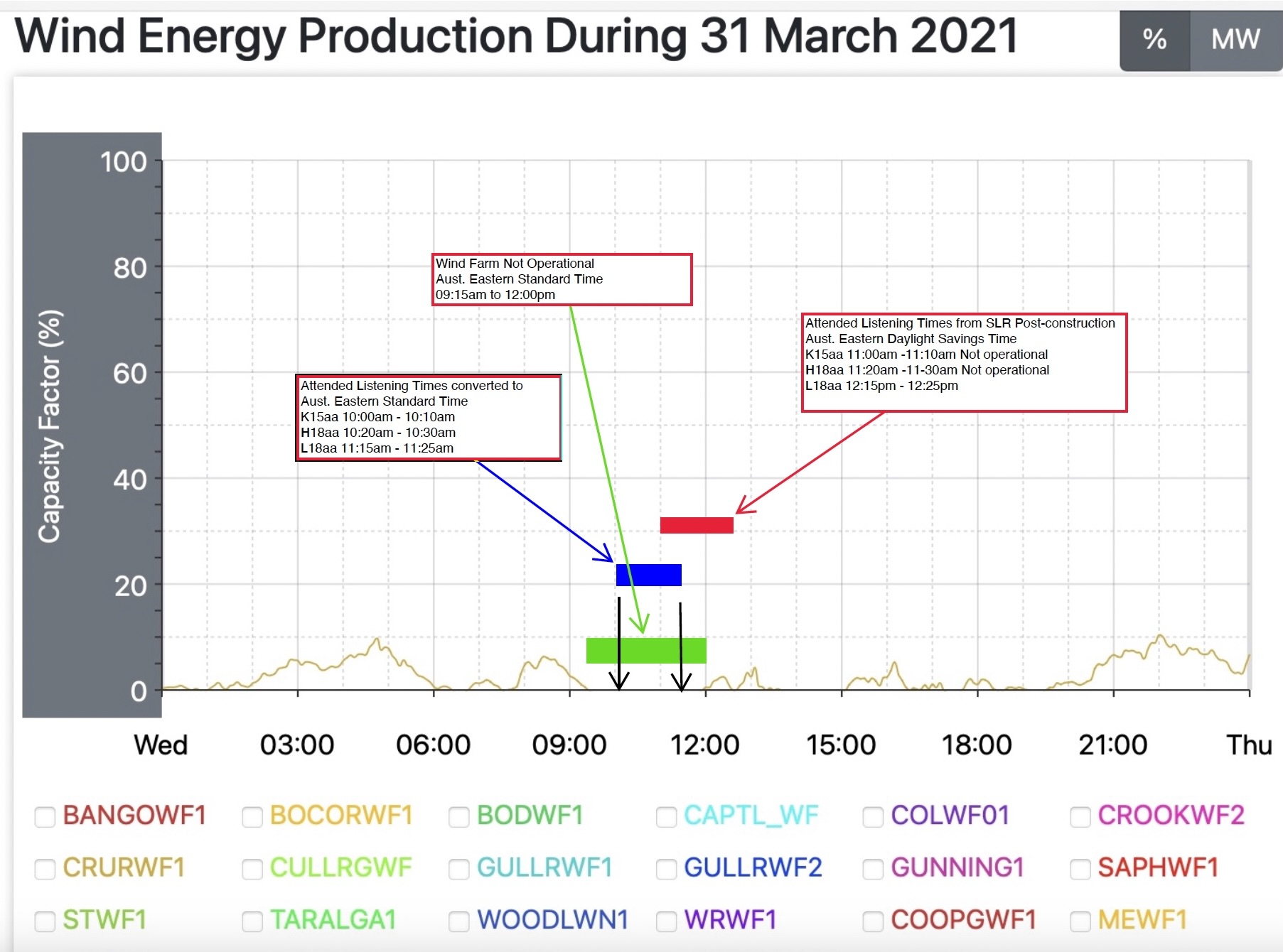
This figure is published beneath the public information session and transcript because it relates to the Q&A discussion concerning the Stage 1 Elaine attended observations, daylight saving time and whether the wind turbines were operating during the recorded observation periods.
Document type: Historical reconstruction / analytical exhibit
Prepared by: Beneficiary
Document provenance: Historical documentary record assembled by the Beneficiary prior to establishment of the Trustee's continuing administrative record.
The figure was prepared as a historical reconstruction using publicly available AEMO generation data, the attended observation times recorded in Appendix D of the Stage 1 Elaine Post-construction Noise Assessment, and contemporaneous documentary material then available.
Following execution of the Owen Robert Inter Vivos Trust, the Trustee incorporated the figure into the continuing administrative record as historical reference material. It is published to assist readers in understanding the chronology of the attended observations discussed during the public SLR Information Session, including Question 1 (Part B) raised by the Beneficiary. At approximately 53:53 of the Information Session, SLR's Technical Director addressed the relationship between the attended listening observations, the AEMO generation data and the applicable time reference, including an explanation concerning Australian daylight saving time.
SLR's Technical Director stated:
“I just will hasten that you can't really make any conclusions based between the survey times or strictly make any conclusions around the survey times. There almost certainly is a discrepancy in the time datum used. Our survey times being in March would have been with Australian daylight savings time and I suspect you'll find the AEMO times are probably just Australian Eastern Standard Time, so they don't have to deal with daylight saving, so there's probably an hour out difference. So I guess there's no conspiracy there. It's likely that it was in one of the periods when it was operating, albeit at a low level.”
These links preserve the existing document access while placing the technical reports into the new learning pathway.
Technical reports should also be read with the later agency correspondence and Freedom of Information record. The Agency Records gateway identifies where EPA Victoria, DTP, Moorabool Shire Council and the AEIC referred to, relied upon, received or disclosed technical material within the currently published record.
The report released under DTP FOI CS015466 is now available in full. A dedicated documentary guide separates the planning-stage prediction, formal post-construction assessment pathway, later correspondence and EPA reliance record.
The three published ARUP verification statements consistently identify the Marshall Day predictive assessment dated 17 January 2018. Highlighted extracts and complete reports are now available in the Sonus documentary guide.
The October 2022 NMP is read alongside the endorsed NCTP, the receiver-location framework, background-noise reports, EPA correspondence, auditor-verification requirements and the FOI custody record.