
NZS 6808:2010
The technical standard forming part of the Lal Lal Wind Farm planning and noise-compliance framework, examined through its mandatory language, defined concepts, approved testing methodology and later documentary application.
How the Standard is used in this record
This page does not reproduce NZS 6808:2010 or attempt to replace the Standard. It identifies the role of the Standard within the governing documentary hierarchy and directs readers to the source records through which its requirements were applied, reported, verified and later relied upon.
Governing status
The Standard is read through the Planning Permit and the endorsed Noise Compliance Testing Plan. Its relevance arises from that governing chain, not as a stand-alone technical reference.
Mandatory language
Where the Standard uses mandatory language, the documentary question is whether the disclosed record enables the corresponding requirement to be traced through the approved methodology and assessment material.
Documentary verification
The record distinguishes the text of the requirement, the evidence of implementation, any identified documentary gap, the response received and the present documentary position.
Regulation 131B and the authorising document
The Environment Protection Regulations 2021 determine the relevant noise standard for a wind energy facility by reference to the authorising document applying to that facility. Regulation 131B identifies NZS 6808:2010 as the relevant standard where the authorising document was issued on or after 1 January 2011, or was amended to require compliance with NZS 6808:2010.
Modification through an authorising document
Regulation 131B also recognises an authorising document that sets out conditions modifying or replacing provisions of NZS 6808:2010. The documentary question is therefore whether any claimed departure, substitution or alteration is identified in the Planning Permit or an incorporated document forming part of that authorising framework.
For the Lal Lal Wind Farm, the record examines the Planning Permit, Condition 25 and the endorsed Noise Compliance Testing Plan to identify the project-specific pathway through which NZS 6808:2010 was applied.
EPA's administrative explanation
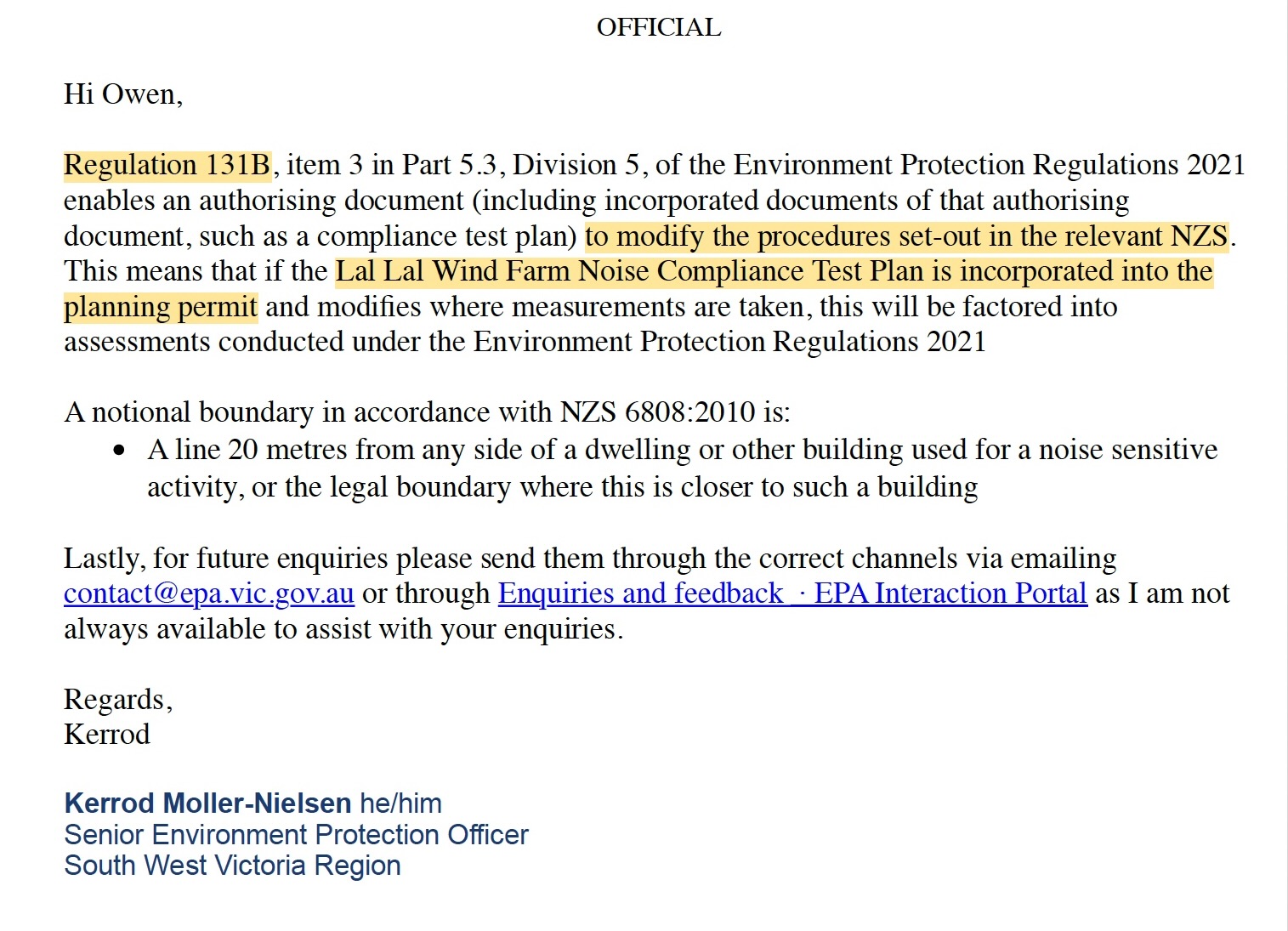
EPA correspondence states that Regulation 131B enables an authorising document, including an incorporated document such as a compliance test plan, to modify procedures set out in the relevant NZS. EPA further stated that, where the Lal Lal Wind Farm Noise Compliance Testing Plan is incorporated into the Planning Permit and modifies where measurements are taken, that modification will be factored into assessments under the Environment Protection Regulations 2021.
This correspondence is recorded as EPA's administrative explanation. The repository separately tests whether the Planning Permit and endorsed NCTP identify the relevant modification and whether that pathway can be traced through the disclosed source record.
The Standard sits within a connected chain
NZS 6808:2010 is not treated in isolation. The relevant question is how the Standard was incorporated, operationalised and evidenced across the project record.
Core NZS-linked concepts used throughout the record
Definitions are anchored in the Glossary so that the same wording and analytical meaning are used consistently across the repository.
Background sound
The Standard defines background sound by reference to the A-frequency-weighted L90 centile level measured before installation of wind turbines in an area. This concept is central to the K15aa pathway.
Noise-sensitive location
The location at which background sound, predicted levels and post-construction assessment must be understood within the approved methodology.
Notional boundary
The assessment-location concept relevant to the relationship between a dwelling, its surrounding boundary and the point at which compliance assessment is undertaken.
Special Audible Characteristics
The sound-character pathway involving observation, assessment, reporting and any applicable adjustment.
Pre-construction monitoring
The baseline stage used to establish the background relationship before wind farm operation.
Post-construction monitoring
The operational assessment stage used to compare measured wind farm sound against the applicable limit framework.
How the record tests an NZS-linked requirement
The same six-step documentary method used elsewhere in the repository applies to every NZS-linked question.
Six-step method
What the method avoids
The record does not assume that a requirement was satisfied merely because a later report states a conclusion, and it does not infer non-compliance solely because a document has not been located.
Instead, it records what the governing material requires, what evidence is available, what remains unidentified and whether a response resolves the documentary question.
12 August 2026 — DTP position on the source of monitoring methodology
A DTP Energy and Infrastructure Assessment response, later supplied to the Beneficiary by a third party, states that the planning-permit application framework requires a pre-construction predictive noise assessment conducted in accordance with NZS 6808:2010.
DTP stated that the Victorian Wind Energy Facility Turbine Noise Guideline does not supplement the requirements in Clause 52.32 and NZS 6808:2010. When asked whether representative monitoring methodology derives its authority from another legislative or policy mechanism, DTP stated: “The monitoring methodology is set out in NZS 6808:2010.”
Principal NZS-linked documentary issues
| Issue | Governing question | Primary evidence pathway |
|---|---|---|
| K15aa background sound | Can the updated background sound record required before operation be reconciled with the Standard's definition of background sound and the approved NCTP methodology? | NCTP, K15aa report, commissioning chronology, Annex A and Documentary Verification Schedule. |
| Noise-sensitive locations | Does the disclosed record identify how mandatory location requirements were applied across baseline monitoring, operational monitoring and compliance assessment? | NCTP, K15aa, technical reports and auditor material. |
| Notional boundary | Can the relationship between the dwelling, notional boundary and later assessment location be verified from the disclosed source material? | NCTP, K15aa, technical reports, correspondence and any identified authorising instrument. |
| Special Audible Characteristics | Does the available record enable independent verification of attended observations, assessment periods, reporting and any applicable character adjustment? | NCTP, SAC reports, Annex B and Documentary Verification Schedule. |
| Mandatory language | Where the Standard or NCTP uses “shall”, “must” or equivalent mandatory wording, can the required act and evidence of performance be traced in the administrative record? | Framework, Verification, auditor documents and agency responses. |
| Modification or substitution | Where a later methodology differs from the approved pathway, does the record identify the authorising document contemplated by Regulation 131B and the condition, approval or governing basis for that change? | Environment Protection Regulations 2021, Planning Permit, endorsed NCTP, permit amendment record, agency material, FOI decisions and technical correspondence. |
What this page establishes
The Standard supplies defined technical concepts and mandatory assessment requirements. The NCTP translates those requirements into the approved project-specific testing pathway. The remaining issue for each evidence page is whether the disclosed record enables that pathway to be followed from requirement to implementation and later reliance.
Established by the record
NZS 6808:2010 forms part of the project noise-control framework through the permit and NCTP documentary chain.
Tested through source material
The repository compares each relevant requirement with reports, chronology, auditor material, agency correspondence and FOI disclosures.
Not determined here
This page does not make a final finding of compliance, breach, liability, nuisance or statutory interpretation.
Follow the project-specific application
The NCTP should be read next because it is the endorsed project methodology connecting the Standard to the later monitoring and reporting record.
NCTP
The approved project-specific pathway through which NZS 6808 requirements were to be implemented.
K15aa
The updated background sound report and associated baseline-integrity questions.
SAC
The attended-observation and sound-character assessment pathway.
Pre-construction assessments
The predictive assessment, peer-review and background-monitoring lineage.
Technical reports
The broader report set through which later application and reliance can be traced.
FOI record
The custody and disclosure pathway for documents relied upon by public authorities.
Primary documents and further reading
This page is a guide. The governing and evidentiary record remains in the source documents.
- Environment Protection Regulations 2021 — Regulation 131B, together with EPA correspondence explaining its application to the Lal Lal Wind Farm authorising-document pathway
- Planning Permit PL-SP/05/0461-2
- Planning Permit PL-SP/05/0461/C
- Noise Compliance Testing Plan
- Annex A – K15aa Baseline Integrity and Regulatory Reliance
- Annex B – SAC-01
- Documentary Verification Schedule
- Supporting Record and Analytical Memorandum v1.3
Agency and disclosure records
Agency correspondence, auditor material and FOI decisions show how NZS-linked questions were described, relied upon and answered within the public administrative record.